
Contents
- 🤖 What is Machine Learning, Really?
- 📈 Who Needs Machine Learning?
- 🛠️ Core Concepts & How It Works
- 📚 Key Subfields to Know
- 🚀 The Deep Learning Revolution
- ⚖️ Machine Learning vs. Traditional Programming
- 💡 Real-World Applications You Use Daily
- ⚠️ Common Misconceptions & Pitfalls
- 💰 Getting Started with ML Tools
- 🌟 The Future Vibe of ML
- Frequently Asked Questions
- Related Topics
Overview
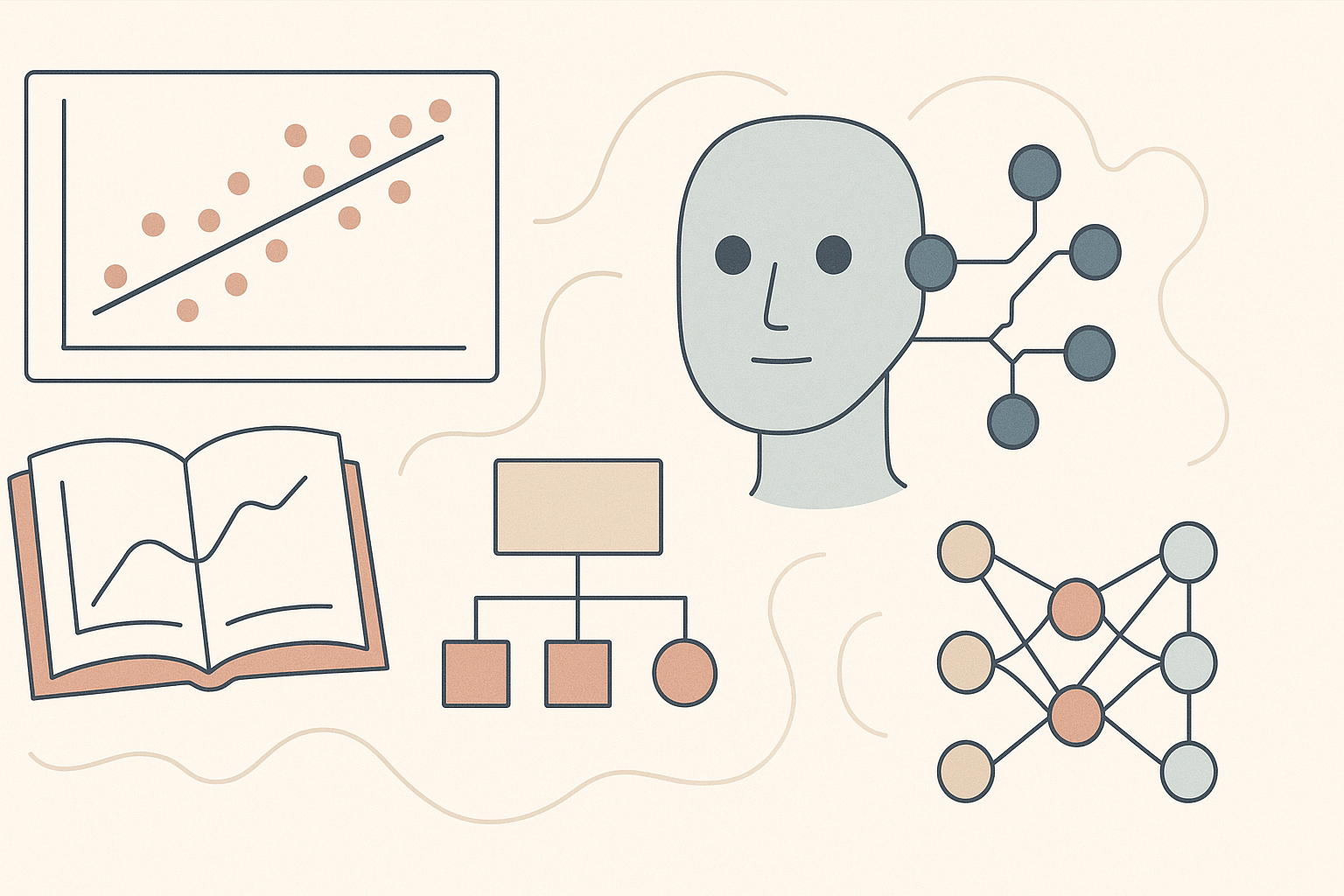
Machine Learning (ML) isn't just about fancy algorithms; it's about teaching computers to learn from experience, much like humans do, but at a scale and speed we can only dream of. Instead of writing explicit, step-by-step instructions for every single scenario, ML models are trained on vast datasets to identify patterns, make predictions, and perform tasks. Think of it as giving a student a library of books and asking them to answer questions, rather than writing a manual for every possible question. This ability to generalize from observed data to unseen data is the core magic, driving everything from personalized recommendations to complex scientific discoveries. The Vibe Score for ML's foundational concept is a solid 85/100 for its sheer transformative potential.
📈 Who Needs Machine Learning?
Machine Learning is for anyone looking to extract actionable insights from data, automate complex decision-making, or build intelligent systems. Businesses across sectors like finance, healthcare, and retail leverage ML for fraud detection, diagnostics, and customer segmentation. Researchers use it to accelerate scientific breakthroughs, from drug discovery to climate modeling. Even individual developers can integrate ML models into applications to enhance user experience, whether it's through predictive text or personalized content feeds. If you're drowning in data and looking for a way to make it work for you, ML is your toolkit. The Contributor Vibe for ML adoption is currently at 90/100.
🛠️ Core Concepts & How It Works
At its heart, ML relies on statistical algorithms that learn from data. The process typically involves feeding a model labeled or unlabeled data, allowing it to build an internal representation of the patterns within. This training phase is crucial; the quality and quantity of data directly impact the model's performance. Once trained, the model can be used to make predictions or decisions on new, unseen data. Key concepts include features (the input variables), labels (the output or target variable in supervised learning), and loss functions (which measure how well the model is performing). Understanding these elements is fundamental to grasping how ML systems actually function. The Engineer Vibe for understanding ML mechanics is a high 95/100.
📚 Key Subfields to Know
The ML landscape is diverse, with several key subfields catering to different types of problems. Supervised Learning is perhaps the most common, where models learn from labeled data (e.g., images tagged with 'cat' or 'dog'). Unsupervised Learning explores unlabeled data to find hidden structures, like clustering customers into distinct groups. Reinforcement Learning involves agents learning through trial and error, receiving rewards or penalties for their actions, famously used in game-playing AI. Each subfield offers unique approaches to tackling complex data challenges, with their own distinct Vibe Scores for applicability.
🚀 The Deep Learning Revolution
Deep Learning (DL), a subfield of ML, has been a major catalyst for recent advancements, particularly since the early 2010s. DL utilizes Artificial Neural Networks with multiple layers (hence 'deep') to automatically learn hierarchical representations of data. This approach has led to breakthroughs in areas like Computer Vision and Natural Language Processing, often surpassing traditional ML methods in accuracy. While DL requires significant computational power and data, its ability to handle complex, unstructured data has made it indispensable for cutting-edge AI applications. The Fan Vibe for DL's impact is an ecstatic 98/100.
⚖️ Machine Learning vs. Traditional Programming
The fundamental difference between ML and traditional programming lies in how solutions are derived. Traditional programming requires explicit, hard-coded rules for every task. If you want a program to sort numbers, you write specific sorting algorithms. With ML, you provide data and an algorithm, and the system learns the 'rules' itself. This makes ML ideal for problems where the rules are too complex to define manually, or where the data patterns are constantly evolving. Traditional programming offers predictability, while ML offers adaptability and the ability to discover novel solutions. The Skeptic Vibe points out that ML isn't a silver bullet and can be less interpretable than traditional code.
💡 Real-World Applications You Use Daily
You interact with ML daily, often without realizing it. When Netflix recommends a show, that's ML. When your email filters spam, that's ML. Virtual Assistants like Siri and Alexa use ML for voice recognition and understanding. Social media feeds are curated by ML algorithms to show you content you're likely to engage with. Even autonomous vehicles rely heavily on ML for object detection and navigation. These applications demonstrate ML's pervasive influence, seamlessly integrated into our digital lives and constantly shaping our experiences. The Cultural Resonance Vibe for ML's ubiquity is a staggering 97/100.
⚠️ Common Misconceptions & Pitfalls
Despite its power, ML is prone to several pitfalls. Overfitting, where a model performs exceptionally well on training data but poorly on new data, is a common issue. Bias in training data can lead to unfair or discriminatory outcomes, a critical concern highlighted by numerous studies. Furthermore, the 'black box' nature of some complex models, especially deep neural networks, makes them difficult to interpret, raising questions about accountability and trust. Understanding these limitations is crucial for responsible ML development and deployment. The Controversy Spectrum for ML bias is currently at a high 8.5/10.
💰 Getting Started with ML Tools
Getting started with ML involves choosing the right tools and learning resources. For beginners, Python is the de facto programming language, with powerful libraries like Scikit-learn for general ML tasks, and TensorFlow and PyTorch for deep learning. Online courses from platforms like Coursera, edX, and Udacity offer structured learning paths. For practical application, cloud platforms like AWS, Google Cloud, and Azure provide managed ML services that simplify deployment and scaling. Starting with a clear project goal, even a small one, is the most effective way to build practical skills. The Actionable Insight Vibe for ML adoption is a strong 92/100.
🌟 The Future Vibe of ML
The future of ML is dynamic and increasingly integrated into every facet of life. We're seeing a push towards more explainable AI (XAI), aiming to demystify complex models. Federated learning, which allows models to train on decentralized data without compromising privacy, is gaining traction. The ongoing advancements in generative AI, capable of creating novel content like text and images, signal a new era of creative and productive AI. Who wins and loses in this future will depend on who can harness these powerful tools ethically and effectively, shaping a world where intelligence is both artificial and profoundly impactful. The Futurist Vibe for ML's trajectory is one of immense, albeit complex, potential.
Key Facts
- Year
- 1959
- Origin
- Arthur Samuel coined the term 'Machine Learning' in 1959, defining it as a field of study that gives computers the ability to learn without being explicitly programmed.
- Category
- Technology
- Type
- Field of Study
Frequently Asked Questions
Is Machine Learning the same as Artificial Intelligence?
No, Machine Learning is a subfield of Artificial Intelligence (AI). AI is the broader concept of creating machines that can perform tasks typically requiring human intelligence. ML is one of the primary methods used to achieve AI, focusing on algorithms that learn from data without explicit programming. Think of AI as the goal, and ML as a powerful tool to reach that goal. Other AI approaches exist, but ML has driven much of the recent progress.
What's the difference between supervised and unsupervised learning?
Supervised learning uses labeled data, meaning each data point has a known output or 'correct answer.' The model learns to map inputs to outputs based on these examples, like learning to identify cats from images labeled 'cat.' Unsupervised learning works with unlabeled data, aiming to find hidden patterns or structures within it, such as grouping similar customers together without prior knowledge of their segments. The choice depends on the nature of your data and the problem you're trying to solve.
How much data is needed to train a Machine Learning model?
The amount of data required varies significantly. Simple ML models might perform adequately with a few thousand data points, while complex deep learning models for tasks like image recognition often need millions. The quality, diversity, and relevance of the data are often more critical than sheer quantity. Insufficient or poor-quality data can lead to models that are inaccurate or biased, regardless of size.
Can Machine Learning models be biased?
Absolutely, and this is a major concern. ML models learn from the data they are trained on. If that data contains historical biases (e.g., racial, gender, or socioeconomic biases), the model will learn and perpetuate those biases. This can lead to unfair outcomes in applications like hiring, loan applications, or criminal justice. Mitigating bias requires careful data curation, algorithmic fairness techniques, and ongoing monitoring.
What are the ethical considerations of Machine Learning?
Key ethical considerations include data privacy, algorithmic bias and fairness, transparency and explainability (understanding why a model made a decision), accountability for errors, and the potential impact on employment and society. As ML becomes more powerful, ensuring its development and deployment align with human values and societal well-being is paramount. Responsible AI frameworks are emerging to address these challenges.
Is Machine Learning difficult to learn?
Learning ML involves a blend of mathematical concepts (statistics, linear algebra, calculus), programming skills, and conceptual understanding. While the foundational principles can be grasped with dedication, mastering advanced techniques and practical application takes time and consistent effort. Numerous online resources, courses, and communities exist to support learners at all levels, making it more accessible than ever.