
Contents
- 🎵 Origins & History
- ⚙️ How It Works
- 📊 Key Facts & Numbers
- 👥 Key People & Organizations
- 🌍 Cultural Impact & Influence
- ⚡ Current State & Latest Developments
- 🤔 Controversies & Debates
- 🔮 Future Outlook & Predictions
- 💡 Practical Applications
- 📚 Related Topics & Deeper Reading
- Frequently Asked Questions
- References
- Related Topics
Overview
The concept of buoyancy, while famously codified by Archimedes in his treatise "On Floating Bodies" around 250 BCE, likely predates his formalization. Ancient mariners intuitively understood that ships floated, and early civilizations developed methods for lifting heavy objects using water. Archimedes' breakthrough was quantifying this force, demonstrating that it equals the weight of the displaced fluid. This principle was crucial for ancient Greek engineering and naval power. Later, thinkers like Galileo Galilei in the 16th century refined the understanding of fluid mechanics, and Isaac Newton's laws of motion provided a broader framework for forces, including buoyancy. The principle remains a cornerstone of classical physics, with its origins firmly rooted in the Hellenistic period of ancient Greece.
⚙️ How It Works
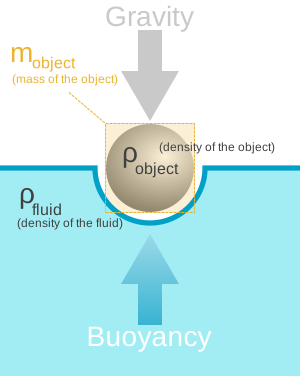
Buoyancy arises from the difference in hydrostatic pressure exerted by a fluid on an immersed object. Pressure in a fluid increases with depth due to the weight of the fluid above. Consequently, the pressure at the bottom of an object submerged in a fluid is greater than the pressure at its top. This pressure differential creates a net upward force, known as the buoyant force. According to Archimedes' principle, the magnitude of this force is exactly equal to the weight of the fluid that the object displaces. If an object's average density is less than the fluid's density, the buoyant force will exceed its weight, causing it to float. Conversely, if its density is greater, its weight will overcome the buoyant force, and it will sink. This is why a steel ship, despite steel being much denser than water, floats: its hull displaces a volume of water whose weight is greater than the ship's total weight.
📊 Key Facts & Numbers
The density of water, a common fluid for buoyancy calculations, is approximately 1000 kg/m³ at standard conditions. A human body's average density is very close to that of water, around 985 kg/m³, which is why we can float with minimal effort. The largest ships, like the container ship MSC Gülsün, can displace over 230,000 tons of water, generating a buoyant force of that magnitude. Submarines can control their buoyancy by adjusting ballast tanks; filling them with water increases density and causes submersion, while expelling water with compressed air decreases density and allows ascent. A cubic meter of air at sea level weighs about 1.225 kg, meaning a hot air balloon must displace a significantly larger volume of cooler, denser air to achieve lift.
👥 Key People & Organizations
The most iconic figure associated with buoyancy is Archimedes of Syracuse (c. 287–212 BCE), the Greek mathematician, physicist, and engineer who first articulated the principle. His legendary discovery, supposedly made while trying to determine if a crown was pure gold, involved observing the water level rise when he submerged himself in a bath. Modern naval architecture relies heavily on the work of engineers like Isambard Kingdom Brunel, whose innovative ship designs, such as the SS Great Eastern, pushed the boundaries of what was thought possible for floating vessels. Organizations like the International Maritime Organization (IMO) establish global standards for ship design and safety, directly incorporating buoyancy principles to prevent maritime disasters.
🌍 Cultural Impact & Influence
Buoyancy is a pervasive force shaping our world and our understanding of it. It's the reason why we can swim, why boats sail, and why balloons ascend. In biology, it influences the locomotion and survival of aquatic organisms, from microscopic plankton to massive whales. The concept has permeated language, with phrases like "keeping your head above water" referring to financial or emotional struggles. In art and literature, the image of sinking or floating often serves as a powerful metaphor for success or failure, hope or despair. The very act of exploring the oceans, from Jacques Cousteau's pioneering work with SCUBA gear to the development of deep-sea submersibles, is fundamentally enabled by our mastery of buoyancy control.
⚡ Current State & Latest Developments
Current research in buoyancy continues to refine our understanding and application of the principle. Advances in materials science are leading to lighter, stronger materials that can be used in buoyancy-critical applications like autonomous underwater vehicles (AUVs) and advanced marine craft. Computational fluid dynamics (CFD) allows for highly accurate simulations of buoyancy and fluid interaction, enabling the design of more efficient and stable vessels. The development of novel buoyancy control systems, such as those using phase-change materials or advanced syntactic foams, is ongoing for deep-sea exploration and offshore energy platforms. The field is also exploring bio-inspired buoyancy mechanisms for robotics and biomimicry.
🤔 Controversies & Debates
While Archimedes' principle is a well-established law, debates can arise in complex scenarios. For instance, the precise calculation of buoyancy for irregularly shaped objects or in non-uniform fluids (like stratified water bodies) can be challenging and may involve approximations. The stability of floating objects, which depends not only on the buoyant force but also on the object's center of buoyancy and center of gravity, is a subject of ongoing engineering analysis. Furthermore, the environmental impact of large floating structures and the potential for their uncontrolled sinking in catastrophic events raise ethical and regulatory questions, though these are more about application and consequence than the fundamental physics of buoyancy itself.
🔮 Future Outlook & Predictions
The future of buoyancy applications is tied to advancements in marine technology and exploration. We can expect to see more sophisticated autonomous vessels for oceanographic research, cargo transport, and defense, all relying on precise buoyancy control. The development of floating cities or habitats, once science fiction, is becoming a more tangible prospect, requiring innovative approaches to buoyancy and stability for large-scale structures. In aerospace, while buoyancy is less dominant than aerodynamics or thrust, principles are applied in lighter-than-air craft for specialized surveillance or cargo transport. The ongoing quest to understand and exploit the oceans will continue to drive innovation in buoyancy-related technologies.
💡 Practical Applications
Buoyancy has a vast array of practical applications. In naval architecture, it's fundamental to designing ships, submarines, aircraft carriers, and life rafts. In civil engineering, it's crucial for designing floating bridges, docks, and offshore platforms. In recreational activities, it explains why kayaks, surfboards, and life jackets work. Hot air balloons and blimps utilize buoyancy for flight. Even in everyday life, understanding buoyancy helps explain why ice floats in water and why we feel lighter in a swimming pool. It's also a key consideration in the design of scientific instruments that operate in or measure fluids.
Key Facts
- Year
- c. 250 BCE
- Origin
- Ancient Greece
- Category
- science
- Type
- concept
Frequently Asked Questions
What is buoyancy in simple terms?
Buoyancy is like an invisible push from water or air that tries to lift things up. It's the reason why a heavy boat can float on the sea and why you feel lighter when you're swimming. This upward push is exactly as strong as the weight of the water or air that the object pushes out of the way.
How does a ship float if it's made of heavy steel?
A ship floats because of its shape and the vast amount of water it displaces. While steel is denser than water, the ship's hull is designed to enclose a huge volume of air. This large volume means the ship pushes aside a weight of water that is greater than the ship's own total weight, including its cargo and crew. This principle, known as Archimedes' principle, ensures the upward buoyant force is sufficient to counteract gravity.
Why do some things float and others sink?
Whether an object floats or sinks depends on its average density compared to the density of the fluid it's in. If the object's average density is less than the fluid's density, the buoyant force will be greater than the object's weight, and it will float. For example, wood floats because it's less dense than water. If an object's average density is greater than the fluid's density, its weight will be greater than the buoyant force, causing it to sink, like a rock in water.
Who discovered the principle of buoyancy?
The principle of buoyancy is famously attributed to the ancient Greek mathematician and inventor Archimedes of Syracuse, around 250 BCE. Legend has it that he discovered the principle when he noticed the water level rise in his bath, realizing that the volume of water displaced was equal to the volume of his submerged body. This insight allowed him to determine the volume of irregularly shaped objects, like the king's crown, by measuring the water they displaced.
Is buoyancy only about water?
No, buoyancy applies to any fluid, which includes both liquids and gases. While we most commonly associate buoyancy with water (e.g., ships, swimming), it also applies to air. For instance, a hot air balloon floats because the hot air inside it is less dense than the surrounding cooler air, creating an upward buoyant force. Similarly, helium balloons rise because helium is less dense than air. The principle is universal to all fluids.
How can I increase my buoyancy in water?
You can increase your buoyancy in water by increasing the volume you occupy relative to your weight, or by decreasing your overall density. This can be achieved by holding onto a buoyant object like a life jacket or a kickboard, which displaces more water for its weight. Relaxing and spreading your limbs can also help, as it increases your body's volume and thus the amount of water displaced. Exhaling fully decreases your lung volume and density, making you sink more easily, while inhaling can slightly increase buoyancy.
What are the future implications of buoyancy research?
Future applications of buoyancy research are likely to focus on advanced marine technologies. This includes more efficient autonomous underwater vehicles for deep-sea exploration and monitoring, as well as novel designs for floating structures like offshore wind farms and potentially even floating cities. Innovations in buoyancy control materials and systems will be key for deep-sea operations and for creating stable, sustainable marine habitats. The principles will also continue to inform the design of next-generation naval vessels and submersibles.