
Contents
Overview
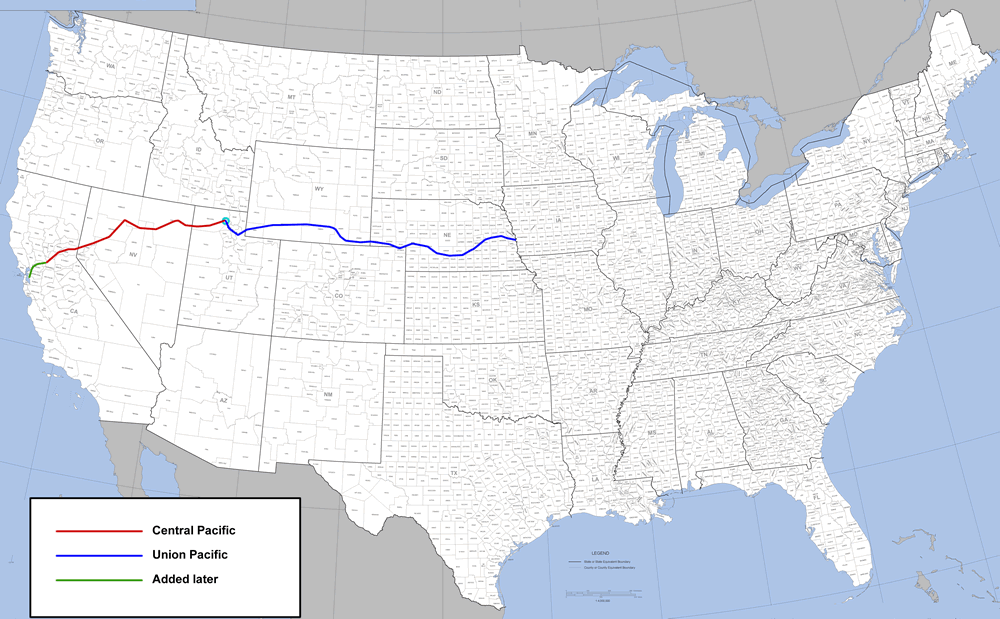
The Central Pacific Railroad (CPRR) was an ambitious undertaking that laid the western track of the First Transcontinental Railroad, a monumental feat of engineering and labor that irrevocably altered the American landscape. Chartered by Congress, the CPRR was tasked with building eastward from Sacramento, California, to meet the Union Pacific Railroad coming from the east. Incorporated in 1861, the company faced immense challenges, including a scarcity of labor and treacherous terrain, which it overcame through the relentless efforts of thousands of workers, notably Chinese immigrants. The railroad's completion in 1869 at Promontory Summit, Utah, not only physically connected the nation but also spurred westward expansion, facilitated trade, and dramatically reshaped the economic and social fabric of the United States. Though it ceased independent operations in 1885, leased to the Southern Pacific Railroad, its legacy as a symbol of American ambition and a catalyst for national unity remains potent.
🎵 Origins & History
The genesis of the Central Pacific Railroad lies in the mid-19th century's fervent desire for a transcontinental link across North America. Following the extensive Pacific Railroad Surveys of the 1850s, numerous proposals for such a line faltered due to deep political divisions, particularly over the issue of slavery, which paralyzed congressional action. However, the secession of Southern states in 1861 cleared the path for the Republican Party's modernizing agenda. The Pacific Railroad Act of 1862, signed into law by President Abraham Lincoln, authorized the construction of a central route, offering financial incentives through land grants and government bonds. The Central Pacific Railroad Company was officially incorporated on June 28, 1861, with its headquarters established in Sacramento, California. Its primary mission was to construct the western portion of this ambitious endeavor, a task that would test the limits of human ingenuity and endurance.
⚙️ How It Works
The construction of the Central Pacific Railroad was a colossal engineering challenge, requiring the movement of millions of tons of earth and the laying of thousands of miles of track through formidable terrain. The company's primary objective was to build eastward from Sacramento, California, across the Sierra Nevada mountains, through Nevada and Utah, to meet the Union Pacific Railroad. This involved immense logistical planning, including the procurement of materials, the organization of labor, and the development of innovative construction techniques to overcome geographical obstacles. The company utilized steam-powered locomotives, heavy machinery for grading, and vast quantities of iron rails and wooden ties. The process involved surveying routes, blasting tunnels through solid rock, building bridges over deep canyons, and grading vast stretches of land, all while managing a workforce that would eventually number in the thousands, including a significant contingent of Chinese laborers who proved indispensable in the most arduous tasks.
📊 Key Facts & Numbers
The Central Pacific Railroad's impact is quantifiable in staggering figures. By the time of its completion on May 10, 1869, the railroad had laid approximately 690 miles of track, connecting Sacramento to Promontory Summit, Utah. This monumental effort required an estimated 10,000 to 15,000 workers at its peak, with Chinese laborers comprising around 80% of the workforce on the western division. The project consumed vast resources, including millions of pounds of iron rails and millions of wooden ties. The government provided subsidies totaling over $60 million in loans and land grants, with the company receiving 13 million acres of public land. The CPRR's construction cost an estimated $120 million. By 1900, the total mileage of U.S. railroads had surged to over 193,000 miles, a direct consequence of the transcontinental precedent set by the CPRR and Union Pacific.
👥 Key People & Organizations
The Central Pacific Railroad was spearheaded by a group of ambitious businessmen known as the "Big Four": Leland Stanford, Collis P. Huntington, Mark Hopkins, and Charles Crocker. Stanford, a former governor of California, served as the company's first president, while Huntington was instrumental in lobbying Congress for financial support and securing crucial contracts. Crocker, the construction superintendent, was known for his hands-on approach and his ability to manage the immense labor force, particularly the Chinese workers. Other key figures included Theodore Judah, a brilliant engineer who championed the railroad's route through the Sierra Nevada and served as the CPRR's chief engineer until his death in 1863. The Union Pacific Railroad was its counterpart, with figures like Grenville Dodge playing a pivotal role in its construction.
🌍 Cultural Impact & Influence
The completion of the Central Pacific Railroad was a watershed moment in American history, profoundly influencing westward expansion, economic development, and national identity. It dramatically reduced travel time from the East Coast to California from months to about a week, opening the West to settlement, agriculture, and industry. The railroad facilitated the rapid exploitation of natural resources, spurred the growth of cities like Sacramento and Reno, and integrated the economies of the West with the rest of the nation. Culturally, it became a potent symbol of American progress and manifest destiny, celebrated in literature, art, and popular imagination. However, its construction also led to the displacement of Native American populations and the exacerbation of anti-immigrant sentiment, particularly against the Chinese laborers who built it.
⚡ Current State & Latest Developments
The Central Pacific Railroad as an independent entity ceased to exist in 1885 when it was leased to the Southern Pacific Railroad Company. This marked the beginning of the Southern Pacific's dominance in the western U.S. rail network. The formal merger of the Central Pacific's assets into the Southern Pacific occurred much later, on June 30, 1959, solidifying the consolidation of rail power in the region. While the physical tracks remain part of the modern Union Pacific and BNSF Railway networks, the distinct corporate identity of the CPRR dissolved into its successor. Today, remnants of its history are preserved in museums, historical sites like the Golden Spike National Historical Park, and through the enduring legacy of the transcontinental line it helped create.
🤔 Controversies & Debates
The construction of the Central Pacific Railroad is fraught with controversy, primarily concerning the treatment and exploitation of its labor force. The Chinese laborers, who performed the most dangerous and back-breaking work, including blasting tunnels and building along sheer cliffs, were paid significantly less than their white counterparts and faced pervasive discrimination. Their vital contributions were often overlooked or minimized in historical accounts for decades. Furthermore, the "Big Four" were accused of corruption and monopolistic practices, using their political influence to secure favorable legislation and land deals, leading to accusations of cronyism and excessive profiteering. The land grants themselves, while intended to incentivize construction, also led to vast land monopolies and contributed to the displacement of indigenous peoples.
🔮 Future Outlook & Predictions
The future of the Central Pacific Railroad's legacy lies in how its story is told and remembered. While the physical railroad is now integrated into larger networks, the historical narrative continues to evolve. There's an ongoing effort to more accurately represent the contributions of Chinese laborers and other marginalized groups, moving beyond the traditional "cowboy" narrative of the West. Future developments might include enhanced preservation efforts at historical sites, more comprehensive digital archives of construction records, and educational initiatives that highlight the complex social and economic forces at play. The ongoing debate about infrastructure development and the role of government in large-scale projects may also draw parallels to the CPRR's ambitious, government-backed construction.
💡 Practical Applications
The most significant practical application of the Central Pacific Railroad was its role in creating the first transcontinental railroad, a feat that revolutionized transportation and commerce in the United States. This connection enabled the rapid movement of goods and people across the country, transforming agriculture, mining, and manufacturing industries. It facilitated westward migration, opening up vast territories for settlement and economic development. The railroad's construction also spurred advancements in engineering, logistics, and labor management, setting precedents for future large-scale infrastructure projects. The principles of financing and land grants established by the Pacific Railroad Act of 1862 influenced subsequent government-supported infrastructure initiatives throughout American history.
Key Facts
- Category
- history
- Type
- topic