
Contents
Overview
The genesis of the Difference Engine can be traced to 1822, when Charles Babbage first proposed his design to the Royal Society. Driven by a desire to eliminate the egregious errors he observed in mathematical tables, particularly those used for navigation and engineering, Babbage envisioned a machine that could compute these values mechanically. The British government provided initial enthusiasm and funding for the project, aiming to produce error-free logarithmic and trigonometric tables. The project, however, was plagued by technical challenges, funding disputes, and Babbage's own perfectionism, leading to its eventual abandonment. Despite the incomplete state of the original machine, Babbage continued to refine his ideas, leading to the even more ambitious Analytical Engine. The core concept, however, remained: a mechanical device capable of automated, reliable computation.
⚙️ How It Works
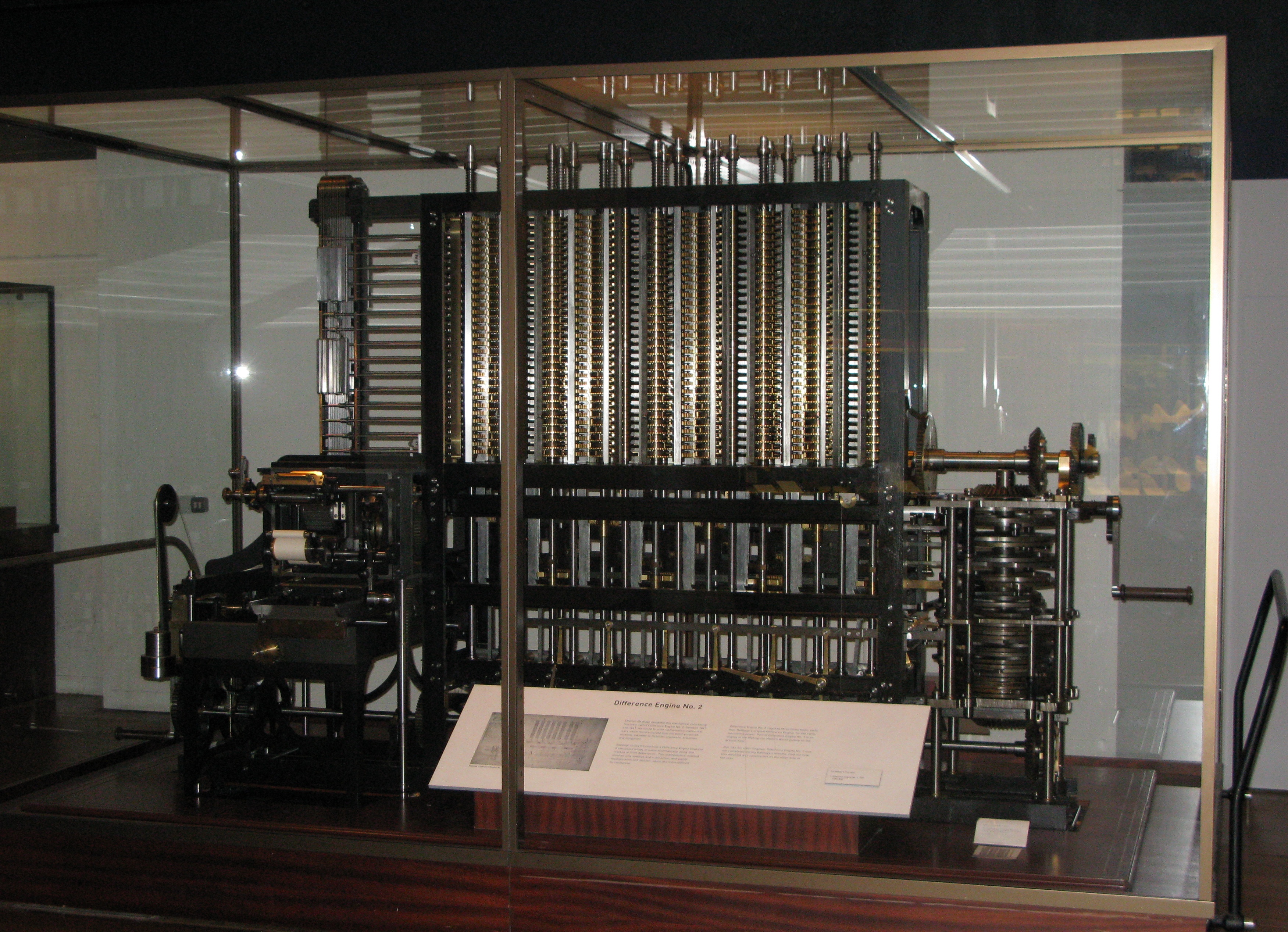
The Difference Engine operates on the principle of finite differences, a mathematical technique for approximating values of polynomial functions. Instead of directly calculating each value of a polynomial, the machine repeatedly adds small, constant increments. For a polynomial like $y = ax^2 + bx + c$, the engine would calculate successive values of $y$ by adding differences. For example, the first difference would be the change in $y$ for a unit change in $x$, and the second difference would be the change in the first difference. For a quadratic polynomial, the second difference is constant. The engine's mechanical design, comprising numerous gears, levers, and cams, was engineered to automatically compute and register these successive differences, thereby generating the desired polynomial values with remarkable accuracy for its time. This process bypassed the need for complex multiplications or divisions for each step, making it significantly faster and more reliable than manual computation.
📊 Key Facts & Numbers
The original Difference Engine No. 1, as designed by Babbage, was intended to stand approximately 8 feet high, 15 feet long, and 3 feet deep, containing an estimated 25,000 precisely machined parts. The estimated cost for its construction was around £17,000 (approximately £2 million in today's currency), a substantial sum for the era. Babbage's second design, the Difference Engine No. 2, was smaller, requiring about 4,000 parts and costing around £4,000. Although Babbage never completed either machine, a working model of Difference Engine No. 2 was constructed by the Science Museum in London in 1991, and a second was built in 2000, demonstrating its functionality. These completed engines weigh approximately 2.5 tons each.
👥 Key People & Organizations
The central figure in the Difference Engine's story is undoubtedly Charles Babbage (1791-1871), a visionary mathematician and inventor. His collaborator, Ada Lovelace, recognized the broader potential of Babbage's machines, particularly the Analytical Engine, and is often credited as the first computer programmer for her notes on its capabilities. The Science Museum in London played a crucial role in realizing Babbage's designs by constructing working models of the Difference Engine No. 2 in the late 20th century, validating his engineering genius. Other key figures include Henry Perkins, Babbage's chief assistant, and George Shultz, who oversaw the construction of the second working model.
🌍 Cultural Impact & Influence
The Difference Engine's influence extends far beyond its mechanical capabilities. It represents a pivotal moment in the conceptualization of automated computation, shifting the paradigm from human calculation to machine-driven processes. This conceptual leap directly informed the development of later computing devices, including Babbage's own Analytical Engine, which introduced the idea of programmability. The pursuit of building the Difference Engine also spurred advancements in precision engineering and mechanical design, contributing to the industrial revolution's technological progress. Furthermore, the story of its incomplete realization and the subsequent efforts to build it have become a compelling narrative in the history of technology, highlighting the challenges and triumphs of ambitious innovation.
⚡ Current State & Latest Developments
While the original Difference Engine was never fully realized by Babbage, its legacy continues to evolve. The successful construction of working models by the Science Museum in London in the 1990s and early 2000s has brought Babbage's designs to life, allowing modern audiences to witness their intricate workings. These reconstructions have not only validated Babbage's engineering prowess but have also inspired renewed interest in mechanical computing and historical technology. Contemporary research continues to explore the theoretical underpinnings of the Difference Engine and its relationship to modern algorithms and computational theory, ensuring its relevance in the digital age.
🤔 Controversies & Debates
A significant controversy surrounding the Difference Engine revolves around its incomplete construction during Babbage's lifetime. Critics often point to the project's substantial cost overruns and delays as evidence of Babbage's impracticality or the government's misplaced investment. However, proponents argue that Babbage was ahead of his time, facing technological limitations and a lack of understanding from his contemporaries. The debate also touches upon the extent of Ada Lovelace's contribution; while she is celebrated for her insights into the Analytical Engine, some historical accounts have perhaps overstated her direct involvement in the Difference Engine's design. The sheer complexity and precision required for its construction, far exceeding contemporary manufacturing capabilities, remain a point of discussion regarding its feasibility.
🔮 Future Outlook & Predictions
The future outlook for the Difference Engine is less about further mechanical development and more about its enduring conceptual legacy. As a historical artifact and a testament to early computational thought, it will continue to be studied and admired. The successful construction of working models has solidified its place in technological history, serving as a tangible link to the dawn of computing. Future explorations might involve more detailed simulations or analyses of its potential performance with advanced materials or manufacturing techniques, though the primary focus will likely remain on its historical and theoretical significance. The Difference Engine's story serves as a perpetual reminder of the long, often arduous, path of technological innovation.
💡 Practical Applications
The primary practical application of the Difference Engine was the automated generation of mathematical tables, such as logarithms, trigonometric functions, and polynomial values. These tables were crucial for scientific research, engineering calculations, and navigation in the 19th century, where manual computation was prone to errors and time-consuming. By providing accurate, error-free tables, the Difference Engine aimed to significantly improve the reliability of scientific and technical work. While the machine itself was not widely deployed due to its incomplete status, the principles it embodied influenced the design of later mechanical calculators and, conceptually, paved the way for the electronic computers that would eventually fulfill its promise of automated calculation on a vastly larger scale.
Key Facts
- Category
- technology
- Type
- topic