
Contents
Overview
Enzyme inhibition studies are a cornerstone of biochemistry and pharmacology, investigating molecules that impede the function of enzymes – the biological catalysts essential for virtually all life processes. These studies explore how inhibitors bind to enzymes, either reversibly or irreversibly, to understand enzyme mechanisms, develop therapeutic drugs, and design biochemical tools. By dissecting these interactions, researchers gain profound insights into cellular pathways, disease mechanisms, and the intricate dance of molecular biology. The field has yielded blockbuster drugs for conditions ranging from hypertension to cancer, demonstrating its immense practical and scientific value. Current research pushes the boundaries with sophisticated computational modeling and the discovery of novel inhibitor classes, promising even more targeted and effective interventions.
🎵 Origins & History
Landmark discoveries, such as the inhibition of acetylcholinesterase by organophosphates, revealed potent and often irreversible mechanisms. James B. Sumner received the Nobel Prize in Chemistry for his work on crystallizing enzymes, further solidifying the biochemical foundation upon which inhibition studies would thrive.
⚙️ How It Works
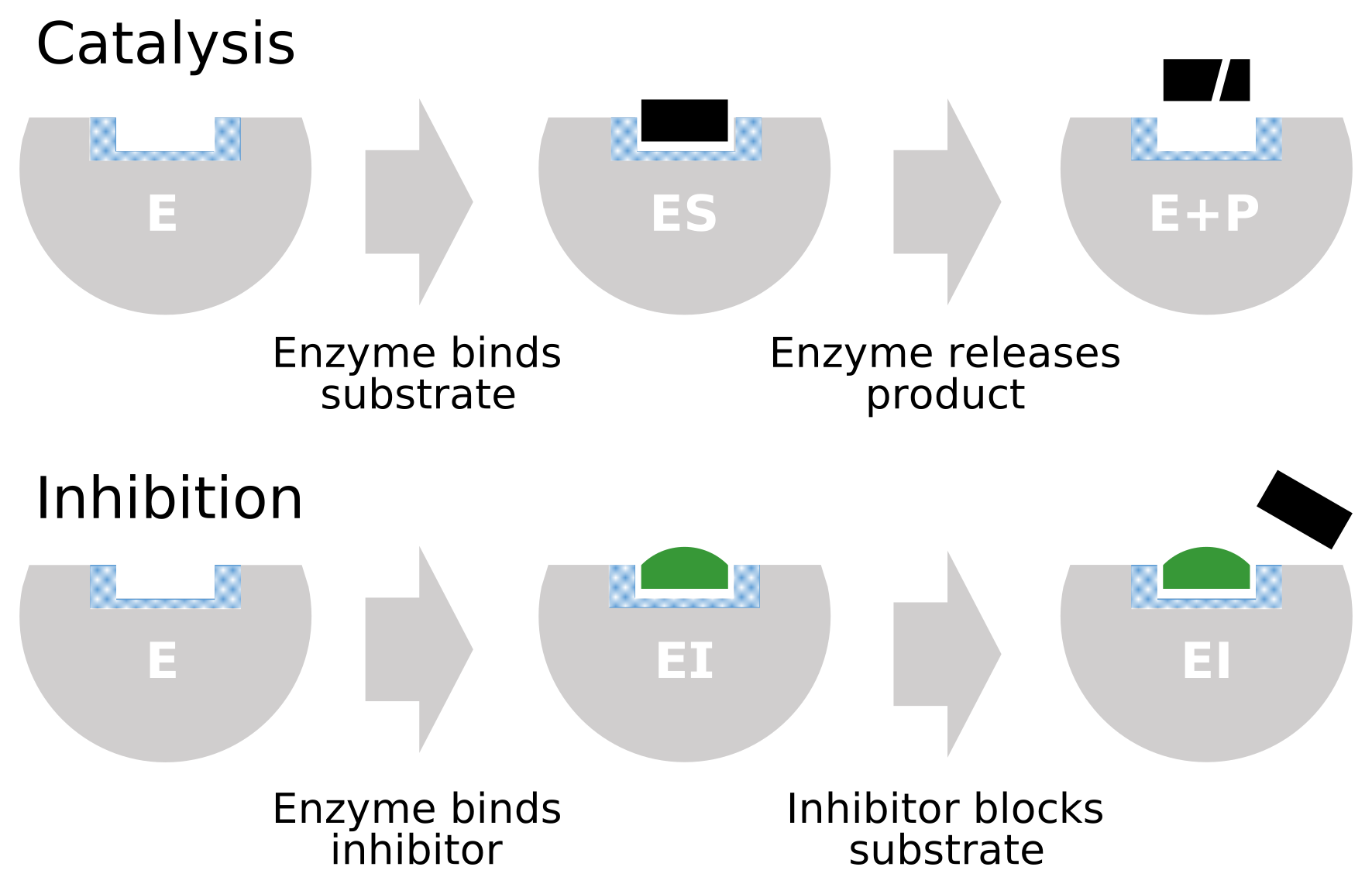
Enzyme inhibition occurs when a molecule, the inhibitor, binds to an enzyme and reduces its ability to catalyze a reaction. This binding can be competitive, where the inhibitor mimics the enzyme's natural substrate and competes for the active site, or non-competitive, where the inhibitor binds to an allosteric site, altering the enzyme's conformation and reducing its efficiency. Reversible inhibitors bind through non-covalent interactions like hydrogen bonds or van der Waals forces, allowing them to dissociate and the enzyme to regain activity. Irreversible inhibitors, however, form stable covalent bonds with the enzyme, permanently deactivating it until new enzyme molecules are synthesized. Understanding these distinct binding modes, often elucidated through enzyme kinetic analyses and X-ray crystallography, is crucial for designing specific and effective inhibitors.
📊 Key Facts & Numbers
Statins, a class of cholesterol-lowering drugs, are HMG-CoA reductase inhibitors. Proton-pump inhibitors (PPIs), used to treat acid reflux, represent another multi-billion dollar market. The development of a single successful enzyme inhibitor drug can generate billions in revenue, underscoring the economic significance of these studies.
👥 Key People & Organizations
Pioneering figures in enzyme inhibition studies include Albert L. Lehninger, whose foundational textbooks on biochemistry extensively covered enzyme mechanisms and inhibition. Linus Pauling's work on the transition-state theory provided a theoretical framework for understanding how inhibitors could achieve high affinity by mimicking the enzyme's transition state. Researchers at companies like Pfizer and Merck have been instrumental in developing numerous enzyme inhibitor drugs. Organizations such as the American Society for Biochemistry and Molecular Biology (ASBMB) and the Biochemical Society foster research through conferences and publications, connecting scientists globally. Emmanuelle Charpentier and Jennifer Doudna, Nobel laureates for their work on CRISPR-Cas9, also utilize enzyme inhibition principles in their gene-editing technologies.
🌍 Cultural Impact & Influence
Enzyme inhibition studies have profoundly shaped modern medicine and biotechnology. The development of antibiotics like penicillin, which inhibits bacterial cell wall synthesis by targeting transpeptidases, revolutionized infectious disease treatment, saving millions of lives. Beyond medicine, enzyme inhibitors are used in agriculture as herbicides and pesticides, and in industrial processes to control unwanted enzymatic reactions. The cultural impact is seen in public health advancements and the widespread availability of life-saving medications.
⚡ Current State & Latest Developments
Current research in enzyme inhibition is characterized by an increasing focus on precision and specificity, driven by advances in computational chemistry and structural biology. Techniques like cryo-electron microscopy (cryo-EM) are providing unprecedented atomic-level detail of enzyme-inhibitor complexes, enabling more rational drug design. The development of 'covalent irreversible inhibitors' is seeing a resurgence, with new strategies to ensure target specificity and minimize off-target effects. Furthermore, the study of enzyme dynamics and allosteric modulation is gaining traction, moving beyond simple active-site inhibition to control enzyme function through more subtle mechanisms. The integration of artificial intelligence and machine learning in predicting inhibitor efficacy and identifying novel targets is also accelerating discovery pipelines.
🤔 Controversies & Debates
A significant debate revolves around the development of resistance to enzyme inhibitor drugs, particularly in the context of cancer and infectious diseases. For example, the emergence of drug-resistant tuberculosis strains poses a major challenge to existing anti-mycobacterial enzyme inhibitors. Another area of contention is the potential for off-target effects and toxicity associated with irreversible inhibitors, prompting rigorous safety evaluations and the development of prodrug strategies. The ethical considerations of using enzyme inhibitors in non-therapeutic contexts, such as performance enhancement in sports or as chemical weapons, also remain a subject of ongoing discussion and regulation.
🔮 Future Outlook & Predictions
The future of enzyme inhibition studies is poised for even greater sophistication and impact. We can anticipate the development of highly personalized enzyme inhibitors tailored to an individual's genetic makeup, particularly in oncology, where tumor-specific mutations can be targeted. The exploration of novel inhibitor modalities, such as RNA interference (RNAi) and gene therapy approaches that modulate enzyme expression, will likely expand. Furthermore, the application of enzyme inhibitors in synthetic biology and metabolic engineering holds promise for creating novel biochemical pathways for sustainable chemical production and advanced materials. The ongoing quest for inhibitors with exquisite selectivity and minimal side effects will continue to drive innovation, potentially leading to cures for diseases currently considered intractable.
💡 Practical Applications
Enzyme inhibition studies have direct applications across numerous fields. In medicine, they are fundamental to developing drugs for a vast array of conditions, including hypertension (e.g., ACE inhibitors), cancer (e.g., tyrosine kinase inhibitors), viral infections (e.g., reverse transcriptase inhibitors), and neurological disorders. In agriculture, inhibitors are used as herbicides (e.g., glyphosate targeting EPSP synthase) and insecticides (e.g., neonicotinoids affecting insect acetylcholine receptors). Industrial biotechnology employs inhibitors to control enzymatic spoilage in food products or to optimize fermentation processes. Research laboratories widely use specific inhibitors as chemical probes to elucidate enzyme function and map metabolic pathways within cells.
Key Facts
- Category
- science
- Type
- topic