
Contents
Overview
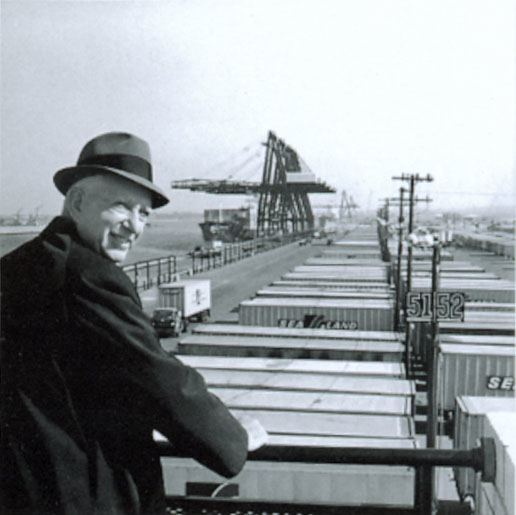
Malcolm McLean’s journey to revolutionizing shipping began not in a boardroom, but on the docks of his own trucking company. Born in rural North Carolina in 1913, McLean’s early life was marked by a pragmatic approach to problem-solving. After saving up to buy his first truck in 1934, he founded McLean Trucking Company with his siblings. The company grew steadily, but it was the sight of laborious, time-consuming cargo handling at ports that truly sparked his revolutionary idea. He observed how much time and money was lost transferring goods piece by piece, a process ripe for disruption. This frustration, coupled with a keen understanding of logistics, laid the groundwork for what would become the modern shipping container, a concept he would eventually patent in 1956.
⚙️ How It Works
The genius of McLean’s intermodal container system lies in its standardization and simplicity. Instead of loading diverse crates, barrels, and sacks onto ships, McLean proposed using uniform metal boxes that could be pre-loaded at the factory or warehouse. These containers, initially based on surplus military truck trailers, were designed to fit precisely onto specially adapted trucks, railcars, and ships. The key innovation was the ability to lift the entire container with a crane and transfer it without disturbing the contents. This eliminated the need for manual cargo handling at each transit point, drastically reducing labor costs, transit times, and the risk of damage or pilferage. The system’s success hinged on the adoption of standardized dimensions, a crucial step that enabled seamless movement across different modes of transport.
📊 Key Facts & Numbers
The impact of McLean’s invention is staggering. Today, over 200 million shipping containers are in circulation globally, moving trillions of dollars worth of goods each year. The Port of Los Angeles, a direct descendant of McLean’s vision, handles over 10 million twenty-foot equivalent units (TEUs) annually, a testament to the scale of his innovation.
👥 Key People & Organizations
While McLean was the singular visionary, the widespread adoption of containerization involved numerous individuals and organizations. His initial efforts were met with skepticism, but he found crucial allies in figures like Keith Tantlinger, who helped refine the container’s design and championed standardization. McLean’s own company, McLean Trucking, was instrumental in early trials, but it was the formation of Sea-Land Service, Inc. in 1960, which he co-founded, that truly propelled container shipping forward. Major shipping lines like A.P. Moller – Maersk and CMA CGM Group later became giants in the container shipping industry, building upon the foundation McLean laid. International organizations like the International Organization for Standardization (ISO) were vital in establishing the global standards that made intermodalism possible.
🌍 Cultural Impact & Influence
Malcolm McLean’s invention didn't just change shipping; it fundamentally altered the global economy and the very fabric of international trade. Containerization is widely credited as a primary enabler of modern globalization, dramatically lowering the cost of goods and making products from distant lands accessible to consumers everywhere. It spurred the growth of massive port cities and logistics hubs, transforming coastal economies. The efficiency gains also contributed to the decline of traditional manufacturing in high-cost countries and the rise of global supply chains. The ubiquity of the humble shipping container, a symbol of global commerce, is a direct cultural legacy of McLean’s ingenuity, influencing everything from urban planning to international relations.
⚡ Current State & Latest Developments
The principles of intermodal containerization pioneered by Malcolm McLean remain the bedrock of global logistics. While the containers themselves have evolved with improved materials and tracking technology, the fundamental system of standardized, transferable units is unchanged. Major ports worldwide continue to invest billions in infrastructure to handle the ever-increasing volume of containerized cargo. The ongoing development of smart containers equipped with IoT sensors for real-time tracking and condition monitoring represents the next evolutionary step. Companies like IBM and SAP are developing software solutions to optimize container logistics, further enhancing the efficiency of McLean’s original concept.
🤔 Controversies & Debates
Despite the undeniable success of containerization, its implementation wasn't without friction. Early resistance from longshoremen unions, who feared job losses due to automation, led to significant labor disputes and strikes. The sheer scale of investment required to retool ports and build specialized vessels also presented a barrier, initially limiting the technology to a few forward-thinking companies. Furthermore, the environmental impact of increased global shipping, including emissions and the potential for invasive species transport via containers, remains a subject of ongoing debate and regulatory scrutiny. The concentration of port operations in a few major hubs also raises questions about regional economic disparities.
🔮 Future Outlook & Predictions
The future of containerized shipping, built on McLean’s foundation, points towards greater automation and digitalization. We can expect continued advancements in autonomous vessels and port operations, further reducing human intervention and potentially increasing efficiency. The development of more sustainable shipping fuels, such as ammonia or methanol, will be critical in addressing the industry’s environmental footprint. McLean’s concept of seamless intermodal transfer will likely extend further, with integrated digital platforms managing cargo flow across all modes of transport. The ongoing challenge will be balancing increased efficiency with environmental responsibility and ensuring equitable distribution of the benefits of global trade.
💡 Practical Applications
The practical applications of Malcolm McLean’s invention are virtually limitless in the modern world. Any product shipped across borders, from electronics manufactured in Asia to agricultural goods from South America, relies on containerization. The system is used for everything from bulk commodities to high-value manufactured goods. The standardized containers themselves have found secondary uses, repurposed as affordable housing, pop-up shops, and even emergency shelters. The efficiency of container handling has also enabled rapid deployment of resources in disaster relief efforts, showcasing the versatility of McLean’s design beyond its original commercial intent.
Key Facts
- Category
- history
- Type
- person