
Vibepedia

Mick Jones | Vibepedia

punk-rock post-punk reggae-fusion songwriter guitarist producer icon
Mick Jones | Vibepedia

Mick Jones stands as a titan in the British rock landscape, primarily celebrated as the co-founder, guitarist, and principal songwriter for the groundbreaking…

Contents

  1. Early Life & Influences
  2. Career & Discography
  3. Legacy & Influence
  4. Cultural Impact
  5. Guitar Style & Production
  6. Frequently Asked Questions
  7. Related Topics

Overview

Mick Jones stands as a titan in the British rock landscape, primarily celebrated as the co-founder, guitarist, and principal songwriter for the groundbreaking band [[the-clash|The Clash]]. His distinctive guitar riffs, lyrical prowess, and genre-bending approach were instrumental in shaping the band's revolutionary sound, which fused punk rock with reggae, ska, rockabilly, and funk. Beyond The Clash, Jones has maintained a prolific and diverse career, including his work in [[big-audio-dynamite|Big Audio Dynamite]] and numerous production credits for a wide array of artists.

Jones's influence extends far beyond his own recorded output. His ability to synthesize disparate musical styles and his keen ear for melody and rhythm have inspired generations of musicians across punk, post-punk, and alternative rock. He is recognized not just for his instrumental skills but also for his role as a visionary who pushed the boundaries of what rock music could be. His continued involvement in music, whether performing, producing, or mentoring, solidifies his status as a pivotal figure in modern music history.

His journey is a fascinating case study in artistic evolution, moving from the raw energy of punk to the more expansive and experimental sounds of his later projects. The enduring appeal of The Clash's catalog, coupled with Jones's eclectic solo and production work, ensures his legacy remains vibrant and relevant, making him a subject of continuous interest for music historians, fans, and aspiring artists alike.

Early Life & Influences

Born in London on June 26, 1955, Mick Jones’s musical journey began amidst the burgeoning rock scene of the early 1970s. Early influences included [[david-bowie|David Bowie]], [[the-stooges|The Stooges]], and the raw energy of [[glam-rock|glam rock]]. He cut his teeth in bands like [[the-delinquents|The Delinquents]] and [[london-ss|London SS]] before a pivotal meeting with [[bernard-rhodes|Bernard Rhodes]] led to the formation of [[the-clash|The Clash]] in 1976 with [[joe-strummer|Joe Strummer]], [[paul-simonon|Paul Simonon]], and [[topper-headon|Topper Headon]]. Jones’s guitar work, characterized by its melodic sensibility and rhythmic complexity, immediately set him apart, providing a crucial counterpoint to Strummer’s more aggressive vocal delivery and lyrical themes.

Career & Discography

As the primary guitarist and songwriter for [[the-clash|The Clash]], Mick Jones was central to the band's unparalleled artistic output. Albums like [[london-calling|London Calling]] (1979) and [[sandanista!|Sandinista!]] (1980) showcased his adventurous spirit, incorporating elements of [[reggae|reggae]], [[ska|ska]], [[funk|funk]], and [[dub|dub]] into a punk framework. His songwriting contributions, often featuring catchy hooks and socially conscious lyrics, were vital to the band's commercial and critical success. After the dissolution of The Clash in 1986, Jones formed [[big-audio-dynamite|Big Audio Dynamite]], further exploring electronic textures and sampling. He has also lent his production talents to artists such as [[pulp|Pulp]], [[the-slits|The Slits]], and [[gabrielle-appleton|Gabrielle Appleton]].

Legacy & Influence

Mick Jones's legacy is deeply intertwined with the enduring impact of [[the-clash|The Clash]] and his own subsequent ventures. He is revered for his pioneering fusion of punk with global music styles, a sonic blueprint that influenced countless bands in the [[post-punk|post-punk]] and [[alternative-rock|alternative rock]] scenes. His distinctive guitar playing, often characterized by its melodic inventiveness and rhythmic drive, continues to be studied and emulated. Beyond his instrumental contributions, Jones’s work as a producer has also been significant, helping to shape the sound of a diverse range of artists and demonstrating his versatility and enduring relevance in the music industry.

Cultural Impact

The cultural significance of Mick Jones cannot be overstated. Through [[the-clash|The Clash]], he and his bandmates became voices of a generation, addressing social and political issues with intelligence and passion. Their music provided a soundtrack for dissent and change, resonating with audiences globally. Jones's ability to infuse punk's raw energy with the rhythms and melodies of [[reggae|reggae]] and [[ska|ska]] was revolutionary, broadening the appeal and scope of punk rock and paving the way for future genre fusions. His work with [[big-audio-dynamite|Big Audio Dynamite]] further cemented his reputation as an innovator, embracing new technologies like sampling and electronic beats, demonstrating a forward-thinking artistic vision that continues to inspire.

Guitar Style & Production

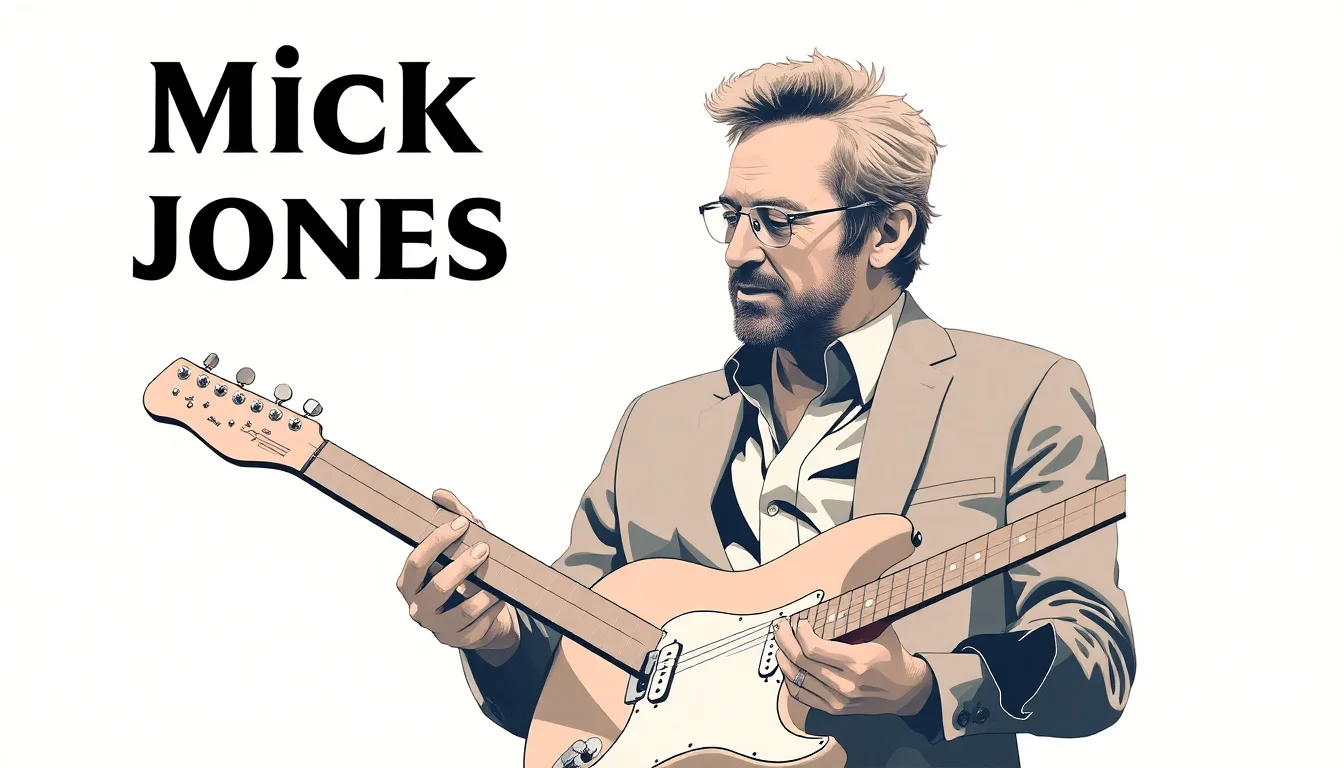
Jones's guitar tone and playing style are instantly recognizable. He often favored Fender Telecasters and Gibson Les Pauls, employing effects like delay and chorus to create his signature layered, atmospheric sound. His solos were rarely gratuitous; instead, they served the song, adding melodic texture and emotional weight. This thoughtful approach to guitar playing, prioritizing songcraft over technical flash, is a key element of his enduring influence on guitarists across various genres. His production work, too, is marked by a similar sensibility, focusing on bringing out the best in the artists he collaborates with, often imbuing their recordings with a distinctive sonic character.

Key Facts

Year
1955
Origin
Watford, Hertfordshire, England
Category
music
Type
artist

Frequently Asked Questions

What was Mick Jones' role in The Clash?

Mick Jones was the lead guitarist and a founding member of The Clash. He was also a key songwriter and vocalist for the band, and his guitar style and technique were a major component of their sound.

What were some of The Clash's most influential albums?

The Clash's most influential albums include London Calling, Sandinista!, and Combat Rock. These albums showcased the band's ability to experiment with different genres and styles, and are still widely admired today.

Who were some of Mick Jones' musical influences?

Mick Jones' musical influences were diverse and far-reaching, and included artists such as The Rolling Stones, The Who, and Bob Marley. He was also influenced by Reggae music, which he saw as a powerful force for social change.

What was Mick Jones' relationship like with Joe Strummer?

Mick Jones and Joe Strummer had a complex and often tumultuous relationship. They were songwriting partners and close friends, but they also had significant creative and personal differences. Their feud in the 1980s was well-documented, but they eventually reconciled before Strummer's death in 2002.

What is Mick Jones' legacy as a musician and songwriter?

Mick Jones' legacy as a musician and songwriter is undeniable. He has been named as an influence by a wide range of artists, and his music with The Clash continues to inspire new generations of fans. His influence can be heard in everything from Punk Rock to Hip-Hop, and he remains a vital and innovative force in the world of music.

What has Mick Jones been working on since The Clash's breakup?

Since The Clash's breakup, Mick Jones has worked on a wide range of music projects, including collaborations with Big Audio Dynamite and The Libertines. He has also worked as a producer and remixer for other bands, and has been involved in various reunion projects with The Clash.

How did Mick Jones contribute to The Clash's sound and legacy?

Mick Jones was instrumental in shaping The Clash's sound and legacy. His guitar style and technique were a key component of their music, and his songwriting partnership with Joe Strummer produced some of the band's most iconic songs. Jones' influence can still be heard in The Clash's music today, and his contribution to their sound and legacy is immeasurable.