
Contents
Overview
The genesis of nuclear chemistry can be traced back to the late 19th and early 20th centuries, a period of explosive discovery in physics. The identification of radioactivity by Henri Becquerel in 1896, followed by the groundbreaking work of Marie Curie and Pierre Curie on radium and polonium in the late 1890s, laid the foundation. Ernest Rutherford's experiments in the early 1910s, which led to the discovery of the atomic nucleus and the concept of nuclear transmutation, were pivotal. The development of the first nuclear reactor by Enrico Fermi and his team at the University of Chicago in 1942, achieving the first self-sustaining nuclear chain reaction, marked a monumental leap, directly birthing the field of applied nuclear chemistry and ushering in the Atomic Age.
⚙️ How It Works
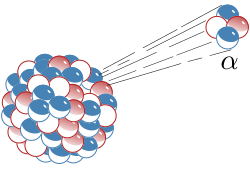
At its core, nuclear chemistry examines the nucleus of an atom, which comprises protons and neutrons bound by the strong nuclear force. It investigates phenomena such as radioactive decay, where unstable nuclei spontaneously emit particles (alpha, beta) or energy (gamma rays) to achieve a more stable configuration. Nuclear fission is another key process, involving the splitting of a heavy nucleus into lighter ones, releasing immense energy and neutrons, which can then induce further fission events in a chain reaction, as seen in nuclear power plants. Conversely, nuclear fusion involves the merging of light nuclei to form a heavier nucleus, releasing even greater amounts of energy, the process powering stars like our Sun. Understanding these processes requires knowledge of nuclear structure, decay modes, cross-sections (the probability of a nuclear reaction), and the behavior of isotopes. Radiation chemistry specifically studies the chemical effects of ionizing radiation on matter, often distinct from the nuclear reactions themselves.
📊 Key Facts & Numbers
The energy released from nuclear processes is staggering; a single uranium-235 fission event releases approximately 200 MeV (mega-electronvolts), equivalent to about 3.2 x 10^-11 joules. Globally, nuclear power currently accounts for roughly 10% of electricity generation, with approximately 440 operational reactors across 32 countries as of early 2024. The half-life of uranium-238, a common isotope, is about 4.5 billion years, while that of carbon-14 is approximately 5,730 years, making it invaluable for radiocarbon dating. The Chernobyl disaster in 1986 released an estimated 5,200 petabecquerels (PBq) of radioactive material into the atmosphere. The International Atomic Energy Agency (IAEA) monitors nuclear materials and facilities worldwide, with over 170 metric tons of plutonium and over 2,000 metric tons of enriched uranium in global stockpiles.
👥 Key People & Organizations
Pioneering figures like Marie Curie (Nobel Prizes in Physics 1903, Chemistry 1911) and Ernest Rutherford (Nobel Prize in Chemistry 1908) are foundational. Lise Meitner, alongside Otto Frisch, provided the theoretical explanation for nuclear fission in 1939, a crucial insight for nuclear chemistry. Glenn Seaborg was instrumental in the discovery and synthesis of numerous transuranic elements, including plutonium, and developed techniques for their separation and purification. Organizations such as the Los Alamos National Laboratory (established 1943) and the Oak Ridge National Laboratory (established 1943) were central to the Manhattan Project and continue to be leading research institutions in nuclear science. The International Union of Pure and Applied Chemistry (IUPAC) plays a role in standardizing nomenclature and terminology within the field.
🌍 Cultural Impact & Influence
Nuclear chemistry's influence extends far beyond the laboratory, permeating global politics, energy policy, and public consciousness. The development of nuclear weapons during the Manhattan Project irrevocably altered international relations, leading to the Cold War arms race and ongoing debates about disarmament. The advent of nuclear power offered a potent, carbon-free energy source, yet remains a subject of intense public debate due to concerns over safety, waste disposal, and proliferation. In medicine, radioisotopes produced through nuclear processes are indispensable for diagnostic imaging (e.g., Technetium-99m) and cancer therapy (e.g., Iodine-131). The cultural impact is visible in science fiction, from the anxieties surrounding nuclear annihilation in films like Dr. Strangelove to the fascination with radioactive superpowers in comic books.
⚡ Current State & Latest Developments
Current research in nuclear chemistry is pushing boundaries in several areas. The development of advanced Small Modular Reactors (SMRs) and next-generation fast breeder reactors aims to improve safety, efficiency, and waste management in nuclear energy. Significant effort is being directed towards the transmutation of long-lived nuclear waste into shorter-lived or stable isotopes, a complex chemical challenge. The search for new superheavy elements continues, with laboratories like the GSI Helmholtz Centre for Heavy Ion Research in Germany and the Joint Institute for Nuclear Research (JINR) in Dubna, Russia, at the forefront. Advances in accelerator technology and detector systems are enabling more precise measurements of nuclear properties and reaction rates, crucial for both fundamental science and applications. The field is also increasingly integrating computational methods, using advanced simulations to predict nuclear behavior and chemical interactions.
🤔 Controversies & Debates
The controversies surrounding nuclear chemistry are as potent as the forces it studies. The primary debate centers on nuclear energy safety and waste disposal. While proponents highlight nuclear power's low carbon footprint and high energy density, critics point to the catastrophic potential of accidents like Chernobyl and Fukushima Daiichi, as well as the unresolved issue of storing radioactive waste for millennia. The proliferation of nuclear weapons technology remains a persistent global security concern, with ongoing debates about arms control treaties and the ethics of nuclear deterrence. Furthermore, the health effects of low-dose radiation exposure are still a subject of scientific discussion, with differing interpretations of epidemiological data influencing regulatory standards. The very definition of 'safe' levels of radiation exposure is a continuous point of contention.
🔮 Future Outlook & Predictions
The future of nuclear chemistry appears poised for significant evolution, driven by the urgent need for sustainable energy and advanced materials. The successful development and deployment of Small Modular Reactors (SMRs) could revolutionize energy production, offering more flexible and potentially safer nuclear power options. Research into fusion energy continues, with projects like ITER aiming to achieve sustained fusion reactions, which, if successful, would offer a virtually limitless and cleaner energy source, though the chemical challenges in materials science for fusion reactors are immense. The field will likely play a critical role in developing advanced materials for extreme environments, from deep space exploration to next-generation electronics. Furthermore, enhanced understanding of radiation effects at the molecular level could lead to novel medical treatments and improved radiation protection strategies, potentially unlocking new frontiers in radiotherapy and radiation biology.
💡 Practical Applications
Nuclear chemistry
Key Facts
- Category
- science
- Type
- topic