
Contents
Overview
The concept of vehicles capable of escaping Earth's gravity and maintaining a stable orbit predates actual spaceflight, appearing in the speculative fiction of writers like Jules Verne and H.G. Wells. However, the scientific and engineering foundations were laid by pioneers such as Konstantin Tsiolkovsky, whose 1903 work 'Exploration of Cosmic Space by Means of Reaction Devices' detailed the principles of rocketry and orbital mechanics. The Soviet Union's Sputnik 1 orbited Earth for 21 days, marking the dawn of the Space Age. This achievement spurred the Space Race between the Soviet Union and the United States, leading to rapid advancements in spacecraft design, including the first human in orbit, Yuri Gagarin, aboard Vostok 1 in 1961, and the first American in orbit, John Glenn, aboard Friendship 7 in 1962. Subsequent decades saw the development of increasingly complex orbital platforms, from Mercury and Gemini capsules to the Apollo lunar missions and the construction of the Skylab and Mir space stations.
⚙️ How It Works
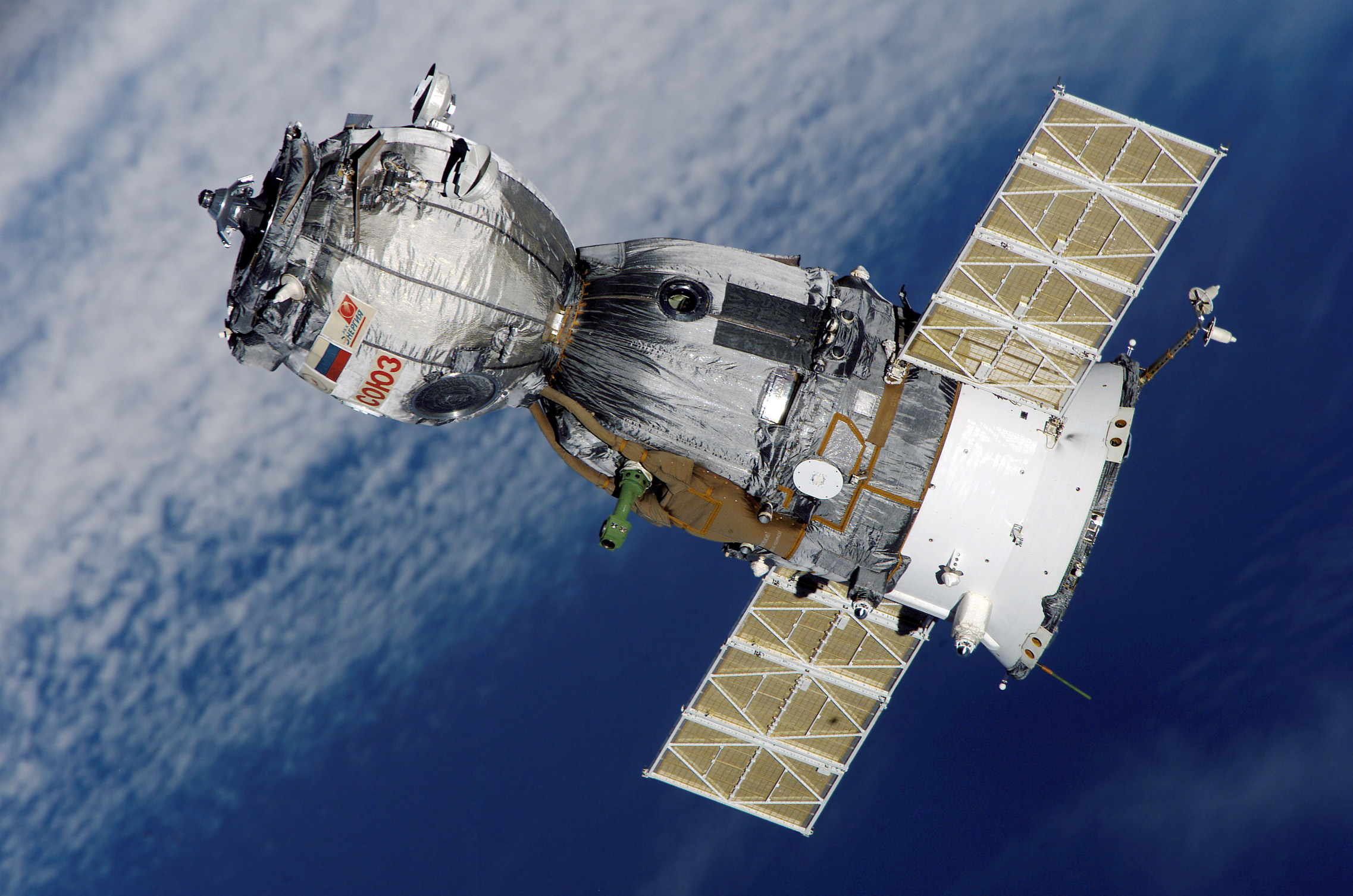
An orbital spacecraft operates by achieving a specific velocity tangential to the celestial body it orbits, counteracting the pull of gravity with its forward momentum. This delicate balance, governed by Newton's laws of motion and Kepler's laws, allows the craft to continuously 'fall' around the planet without impacting it. To achieve orbit, spacecraft typically employ multi-stage rocket engines that provide the necessary thrust to overcome atmospheric drag and reach orbital velocity. Once in orbit, onboard systems manage attitude control, power generation (often via solar panels or RTGs), communication with ground control, thermal regulation, and propulsion for orbital maneuvers. For crewed missions, life support systems are paramount, providing breathable air, water, and temperature control within the habitable modules, such as those found on the International Space Station.
📊 Key Facts & Numbers
The global space economy was valued at an estimated $469 billion in 2021, with satellite services accounting for the largest share at $370 billion. The SpaceX Starlink constellation alone aims to deploy over 40,000 satellites, significantly increasing the number of objects in orbit. The cost of launching a kilogram into low Earth orbit has plummeted from over $10,000 in the early 2000s to under $2,000 for some reusable rocket systems like SpaceX's Falcon 9. The Hubble Space Telescope, launched in 1990, has provided over 1.5 million observations, fundamentally changing our understanding of the universe. The Voyager 1 probe, launched in 1977, is now over 15 billion miles from Earth, the farthest human-made object, operating on a power source designed to last until approximately 2025.
👥 Key People & Organizations
Key figures in the development of orbital spacecraft include Konstantin Tsiolkovsky, the 'father of cosmonautics,' whose theoretical work laid the groundwork for spaceflight. Robert Goddard, an American physicist, is credited with launching the world's first liquid-fueled rocket in 1926, a crucial precursor to orbital vehicles. Sergei Korolev, the chief designer for the Soviet space program, was the mastermind behind Sputnik 1 and Vostok 1. In the United States, Wernher von Braun was instrumental in developing the Saturn V rocket, which powered the Apollo missions. Today, organizations like NASA, the European Space Agency (ESA), Roscosmos, and increasingly, private companies such as SpaceX, Blue Origin, and Virgin Galactic are at the forefront of orbital spacecraft innovation. Elon Musk, through SpaceX, has revolutionized launch costs with reusable rocket technology and is developing the Starship for interplanetary travel.
🌍 Cultural Impact & Influence
Orbital spacecraft have profoundly reshaped human culture and perception. The iconic images of Earth from space, such as the 'Blue Marble' photograph taken during the Apollo 17 mission, fostered a sense of global unity and environmental awareness. The ability to observe Earth from orbit has revolutionized weather forecasting, disaster management, and agricultural planning through Earth observation satellites. Satellite television and GPS have become ubiquitous, altering how we consume media and navigate our world. The pursuit of space exploration, embodied by orbital missions, has inspired generations of scientists, engineers, and artists, fueling countless works of science fiction in literature, film, and art, and solidifying space travel as a potent symbol of human ambition and technological prowess.
⚡ Current State & Latest Developments
The current era of orbital spacecraft is characterized by rapid innovation and increasing commercialization. Starlink and OneWeb are deploying massive satellite constellations for global internet access, fundamentally changing the telecommunications landscape. Private companies are now regularly launching payloads and astronauts to the International Space Station, a capability previously exclusive to national space agencies. The development of reusable rocket technology, pioneered by SpaceX with its Falcon 9 and Falcon Heavy rockets, has drastically reduced launch costs, making space more accessible. Furthermore, the focus is shifting towards more ambitious orbital infrastructure, including commercial space stations like Axiom Space's planned modules and the development of heavy-lift vehicles like SpaceX's Starship for lunar and Martian missions.
🤔 Controversies & Debates
The proliferation of satellites, particularly large constellations like Starlink, has ignited significant debate regarding space debris and orbital congestion. The sheer number of objects in orbit raises concerns about potential collisions, which could trigger a Kessler Syndrome scenario, rendering certain orbits unusable. There are also ethical considerations surrounding the militarization of space, with nations developing anti-satellite weapons and increasing surveillance capabilities. The equitable access to space and the potential for resource exploitation on celestial bodies also present ongoing controversies, as do the environmental impacts of rocket launches and the long-term sustainability of space activities. The question of who 'owns' or governs space remains a complex geopolitical challenge.
🔮 Future Outlook & Predictions
The future of orbital spacecraft points towards an increasingly crowded and dynamic space environment. The development of Starship by SpaceX aims to enable routine interplanetary travel, potentially leading to permanent human settlements on the Moon and Mars. Commercial space stations will likely become hubs for research, manufacturing, and even space tourism. Advanced propulsion systems, such as nuclear-thermal propulsion and ion thrusters, promise faster and more efficient travel within the solar system. We can also anticipate the rise of orbital servicing, a
💡 Practical Applications
Orbital spacecraft are essential for numerous practical applications. Satellite communication enables global broadcasting, internet access, and mobile phone services. Earth observation satellites provide critical data for weather forecasting, climate monitoring, environmental protection, and resource management. Navigation satellites, such as those in the GPS network, are indispensable for transportation, logistics, and personal navigation. Scientific satellites and space telescopes like the Hubble Space Telescope allow us to study distant stars, galaxies, and phenomena, expanding our understanding of the universe. Weather satellites continuously monitor atmospheric conditions, aiding in the prediction of storms and other meteorological events. Military satellites provide reconnaissance, communication, and early warning capabilities.
Key Facts
- Category
- technology
- Type
- topic