
Contents
Overview
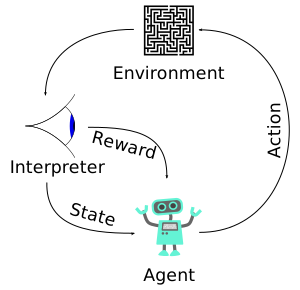
Policy gradients represent a fundamental class of algorithms within reinforcement learning (RL), a subfield of artificial intelligence focused on training agents to make sequential decisions in an environment to maximize cumulative rewards. Unlike value-based methods that learn the value of states or state-action pairs, policy gradient methods directly learn a parameterized policy, which maps states to actions. This direct approach allows for learning stochastic policies, essential for tasks requiring exploration or where optimal actions are inherently probabilistic. This method is particularly powerful for continuous action spaces, where discretizing actions becomes intractable. The development of policy gradients has been a cornerstone in advancing RL capabilities, enabling agents to tackle complex problems in robotics, game playing, and resource management.
🎵 Origins & History
The conceptual roots of policy gradients can be traced back to the early days of optimal control and dynamic programming, where researchers sought methods to optimize sequences of decisions. Early work in the 1990s, notably by Richard Sutton and his colleagues, laid the groundwork for what would become modern policy gradient methods. The REINFORCE algorithm provided a simple yet effective way to estimate the gradient of the policy's expected performance with respect to its parameters. The subsequent development of actor-critic methods, which combine policy-based and value-based approaches, further refined these techniques, leading to more stable and efficient learning.
⚙️ How It Works
Policy gradient algorithms operate by directly optimizing a parameterized policy. Algorithms like REINFORCE use Monte Carlo estimates of the return, while actor-critic methods employ a learned value function (the critic) to provide a lower-variance estimate of the return (the advantage function).
📊 Key Facts & Numbers
The theoretical underpinnings of policy gradients have been rigorously analyzed, with convergence guarantees established under certain conditions. In practice, deep neural networks are often used as function approximators for policies, leading to deep reinforcement learning algorithms capable of handling high-dimensional state spaces. The computational cost of policy gradient methods can be significant, often requiring millions of interactions with the environment to achieve high performance, with some state-of-the-art models training for weeks on hundreds of GPUs.
👥 Key People & Organizations
Key figures in the development of policy gradients include Richard Sutton, whose foundational work in the 1990s established the theoretical basis. David Silver, a leading researcher at DeepMind, has made significant contributions to actor-critic methods and their application in complex games. Major research institutions and companies like DeepMind, OpenAI, and Meta AI are at the forefront of policy gradient research, publishing numerous papers and releasing open-source implementations. The Association for the Advancement of Artificial Intelligence (AAAI) and International Conference on Machine Learning (ICML) are key venues for presenting new advancements in this field.
🌍 Cultural Impact & Influence
Policy gradients have profoundly influenced the trajectory of AI research and development. They are the engine behind many impressive demonstrations of AI capabilities, from mastering complex board games like Go and chess to controlling robotic limbs with remarkable dexterity. The ability of policy gradient methods to learn directly from experience without explicit reward shaping has made them a go-to choice for tasks where defining a precise reward function is challenging. This has fostered a culture of experimentation in AI, where agents are often trained through trial and error in simulated or real-world environments. The success of these methods has also spurred interest in areas like generative modeling and causal inference, as researchers explore how to imbue AI systems with more sophisticated reasoning abilities.
⚡ Current State & Latest Developments
The current state of policy gradient research is characterized by a focus on improving sample efficiency, stability, and scalability. Algorithms like Proximal Policy Optimization (PPO) remain popular due to their robust performance and ease of implementation, often serving as baselines. Researchers are actively exploring techniques such as curriculum learning to accelerate training by gradually increasing task difficulty. Furthermore, the integration of policy gradients with transformer networks and other advanced deep learning architectures is leading to more powerful and generalizable agents. Recent work also investigates the application of policy gradients to multi-agent systems, where multiple agents learn to cooperate or compete in shared environments, with significant progress reported in areas like autonomous driving coordination and complex game simulations.
🤔 Controversies & Debates
A persistent debate in the policy gradient community revolves around the trade-off between sample efficiency and stability. Simpler methods like REINFORCE often suffer from high variance in gradient estimates, leading to unstable learning. More advanced methods like TRPO and PPO aim to mitigate this by introducing constraints or clipping mechanisms, but these can sometimes lead to overly conservative updates, slowing down learning. Another area of contention is the applicability of policy gradients to real-world scenarios where exploration can be costly or dangerous. Critics argue that the extensive exploration required by many policy gradient algorithms makes them impractical for safety-critical applications without significant modifications or careful reward engineering. The interpretability of policies learned by deep neural networks also remains a challenge, making it difficult to understand why an agent makes a particular decision.
🔮 Future Outlook & Predictions
The future of policy gradients appears bright, with ongoing research pushing the boundaries of what AI agents can achieve. We can expect to see further improvements in sample efficiency, potentially bridging the gap between simulation and real-world deployment. The development of more sophisticated exploration strategies, perhaps inspired by human learning, could dramatically reduce training times. Furthermore, the integration of policy gradients with other AI paradigms, such as meta-learning and transfer learning, is likely to yield agents that can adapt to new tasks and environments more rapidly. The application of policy gradients to increasingly complex domains, including scientific discovery, personalized medicine, and advanced robotics, is also a strong possibility. By 2030, it's plausible that policy gradient-based agents will be integral to solving some of humanity's most pressing challenges.
💡 Practical Applications
Policy gradients find application across a diverse range of domains. In robotics, they are used to train robot arms for manipulation tasks, such as grasping objects or assembling components, often in simulated environments before transferring to physical hardware. In autonomous driving, policy gradients can help optimize driving policies
Key Facts
- Category
- technology
- Type
- topic