
Contents
Overview
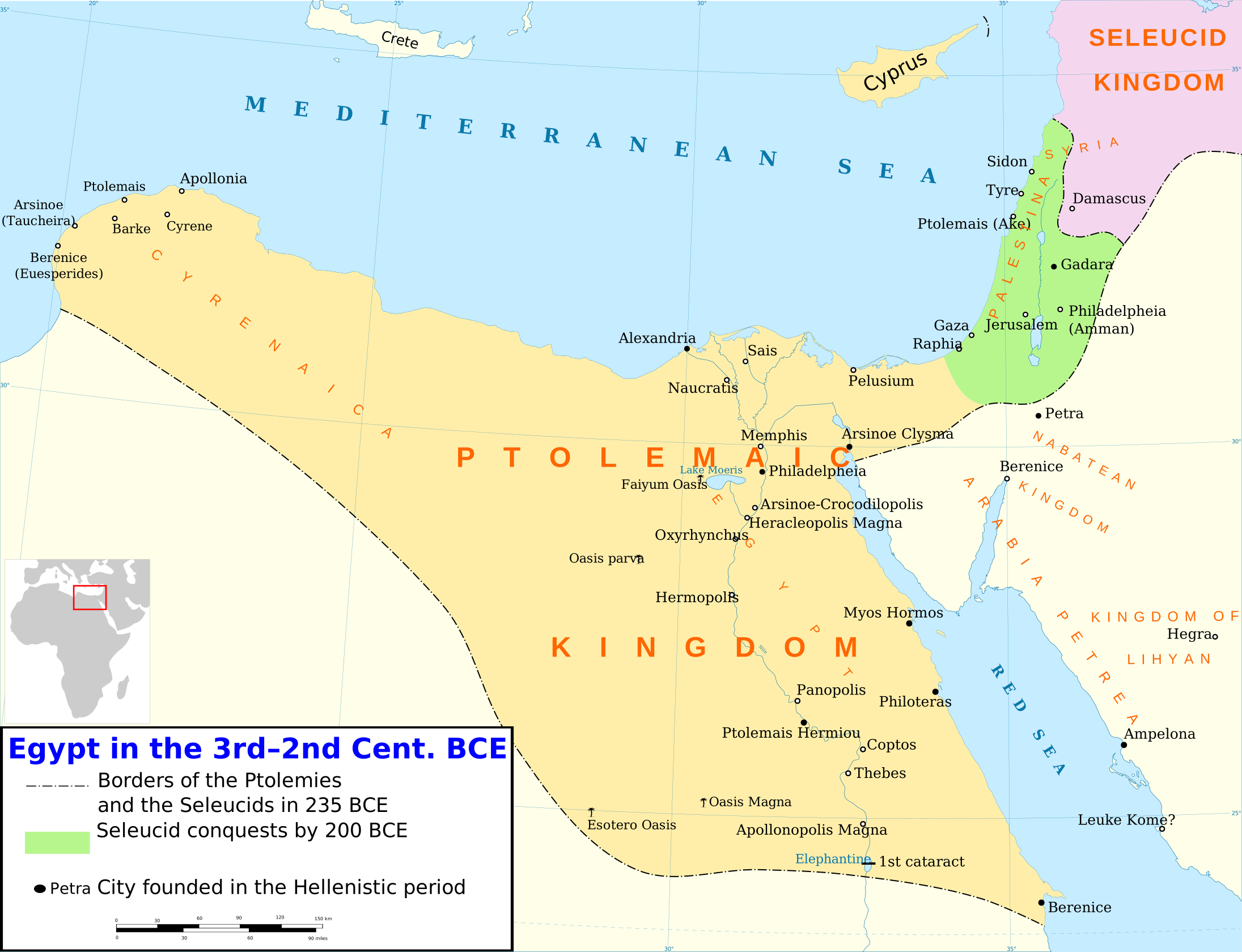
The Ptolemaic Kingdom, a Hellenistic state that reigned in Egypt, represents the final chapter of pharaonic rule and a unique fusion of Greek and Egyptian cultures. Founded by Ptolemy I Soter, a general under Alexander the Great, the dynasty ruled for nearly three centuries, establishing Alexandria as a vibrant center of Hellenistic learning and commerce. This era witnessed significant cultural syncretism, with Greek rulers adopting Egyptian religious practices and iconography, while Greek language and administration dominated. The kingdom's eventual decline, marked by internal strife and Roman intervention, culminated in the death of Cleopatra VII and the annexation of Egypt by Rome in 30 BC, effectively ending the Hellenistic period.
🎵 Origins & History
The Ptolemaic Kingdom’s genesis lies in the chaotic aftermath of Alexander the Great’s death in 323 BC. His vast empire fractured among his generals, the Diadochi, who vied for control in a series of brutal wars. Ptolemy I Soter, a seasoned Macedonian general and close confidant of Alexander, shrewdly secured Egypt, a wealthy and strategically vital territory. He initially ruled as satrap but, by 305 BC, declared himself king, establishing the Ptolemaic dynasty. This marked the beginning of a nearly 300-year reign, making the Ptolemies the longest-ruling dynasty in Egyptian history and the final independent rulers before Roman conquest. Their reign spanned from the early Hellenistic period through the Roman Republic, witnessing the rise and fall of numerous Mediterranean powers.
⚙️ How It Worked: Governance and Society
The Ptolemaic administration was a sophisticated blend of Greek governance and Egyptian tradition. Greek was the official language of the court and bureaucracy, with officials drawn primarily from the Greek and Macedonian elite. However, the rulers also adopted many Egyptian pharaonic customs, patronized Egyptian temples, and even participated in Egyptian religious festivals to legitimize their rule among the native population. Alexandria, the capital, became a cosmopolitan metropolis, a hub for trade, philosophy, and science, boasting the famed Library of Alexandria and the Pharos lighthouse. The economy was largely agrarian, with the state controlling vast tracts of land and levying heavy taxes, particularly on grain, which fueled the kingdom’s wealth and military campaigns.
📊 Key Facts & Numbers
The Ptolemaic Kingdom endured for 295 years, from its founding in 305 BC to its dissolution in 30 BC. During this period, 15 rulers bore the name Ptolemy, with some reigning as co-regents for extended durations. The kingdom’s population at its height is estimated to have been around 7-8 million people, with Alexandria alone housing perhaps 500,000 to 1 million inhabitants. The Ptolemies amassed significant wealth, with annual revenues from Egypt estimated to be in the tens of millions of drachmae at their peak. Their military, particularly their navy, was a formidable force in the Eastern Mediterranean, engaging in numerous conflicts with rivals like the Seleucid Empire and the Antigonids.
👥 Key People & Dynasties
The Ptolemaic dynasty was initiated by Ptolemy I Soter (reigned 305–285 BC), a brilliant general and administrator. His successors, including Ptolemy II Philadelphus (reigned 285–246 BC), who fostered the Library of Alexandria, and Ptolemy III Euergetes (reigned 246–221 BC), who expanded the kingdom’s territory, maintained its power. The later Ptolemies, such as Ptolemy IV Philopator and Ptolemy V Epiphanes, faced increasing internal instability and external pressures. The dynasty’s most famous figure, Cleopatra VII (reigned 51–30 BC), was the last Ptolemaic ruler, whose alliances with Julius Caesar and Mark Antony ultimately failed against the rising power of Octavian (later Augustus).
🌍 Cultural Impact & Influence
The Ptolemaic era left an indelible mark on history, most notably through the intellectual achievements centered in Alexandria. The Library of Alexandria and the Museum attracted scholars from across the Hellenistic world, fostering advancements in mathematics, astronomy, medicine, and literature. Figures like Euclid, Archimedes, and Eratosthenes worked or studied there. Culturally, the syncretism between Greek and Egyptian traditions produced unique religious cults, such as the worship of Serapis, a Greco-Egyptian deity, and the adoption of Egyptian artistic motifs in Hellenistic art. The Ptolemaic legacy also includes the enduring image of Cleopatra VII as a powerful and enigmatic queen, a figure who has captivated imaginations for millennia and inspired countless works of art, literature, and film.
⚡ Current State & Latest Developments
While the Ptolemaic Kingdom ceased to exist in 30 BC, its legacy continues to be unearthed and reinterpreted through ongoing archaeological discoveries and scholarly research. Recent excavations in Alexandria and other sites continue to reveal new insights into daily life, religious practices, and administrative structures of the period. The study of Ptolemaic papyri, such as those found at Oxyrhynchus, provides invaluable primary source material for understanding the socio-economic conditions and legal systems of the time. Furthermore, modern scholarship increasingly focuses on the agency of the native Egyptian population within the Hellenistic framework, challenging older narratives that solely emphasized Greek dominance.
🤔 Controversies & Debates
The Ptolemaic Kingdom is a subject of considerable historical debate, particularly concerning the extent of cultural assimilation versus imposition. Some scholars argue for a genuine syncretism, where Greek and Egyptian cultures mutually influenced each other, while others emphasize the coercive nature of Greek rule and the limited integration of the native population into the ruling elite. The role and agency of Egyptian women, especially within the royal family and priestly classes, are also areas of ongoing discussion. The economic policies of the Ptolemies, particularly their heavy taxation and state control, are debated for their long-term impact on Egypt’s development and their contribution to the kingdom’s eventual vulnerability to Roman expansion.
🔮 Future Outlook & Predictions
The future study of the Ptolemaic Kingdom will likely be shaped by advancements in digital humanities and new archaeological techniques. Sophisticated imaging technologies may reveal hidden details in existing artifacts and structures, while AI-powered analysis of texts could unlock new understandings of Ptolemaic administration and literature. The ongoing geopolitical shifts in the Middle East and North Africa may also influence access to and the focus of archaeological research in Egypt. Future scholarship will likely continue to challenge traditional narratives, emphasizing the complex interactions between Greek rulers and their Egyptian subjects, and exploring the kingdom’s role as a crucial bridge between the ancient Near East and the emerging Roman world.
💡 Practical Applications
The Ptolemaic Kingdom’s administrative and economic structures offer lessons for understanding state-building and resource management in ancient societies. The development of Alexandria as a cosmopolitan center of learning and trade provides a historical model for urban planning and the creation of intellectual hubs. The strategies employed by the Ptolemies to legitimize their rule through cultural and religious patronage continue to be studied in the context of imperial governance and soft power. Furthermore, the kingdom’s agricultural management, particularly its sophisticated irrigation systems and grain production, highlights ancient innovations in resource utilization that sustained a large population and fueled imperial ambitions.
Key Facts
- Category
- history
- Type
- place