
Contents
Overview
The intellectual roots of welfare state ideology can be traced back to Enlightenment thinkers who emphasized social contract theory and the state's role in protecting citizens. The modern form of welfare state ideology began to coalesce in the late 19th century, spurred by industrialization, urbanization, and the rise of socialist and social democratic movements. Otto von Bismarck's Germany introduced pioneering social insurance programs in the 1880s, including health insurance in 1883 and old-age pensions in 1889, and is often cited as the first concrete manifestation of a welfare state. Following World War II, the concept gained significant traction, particularly in Western Europe, influenced by thinkers like John Maynard Keynes and the architects of the Beveridge Report in Britain (1942), which famously proposed a comprehensive system of social security 'from cradle to grave.' This post-war consensus solidified the welfare state as a cornerstone of many developed economies, aiming to balance capitalist growth with social equity.
⚙️ How It Works
Welfare state ideology translates into concrete policy mechanisms designed to provide a safety net and promote opportunity. This typically involves a mix of universal services, such as public education and healthcare, and targeted benefits, like unemployment insurance, disability payments, and pensions. Funding is primarily derived from taxation, often progressive. The state acts as a redistributor of wealth, using tax revenue to fund social programs and public services. Delivery can be a complex interplay between national governments, regional authorities, and private or non-profit organizations, creating a 'mixed economy' of welfare provision. The goal is to ensure a baseline standard of living, reduce poverty, and foster social cohesion by mitigating the harshness of market forces.
📊 Key Facts & Numbers
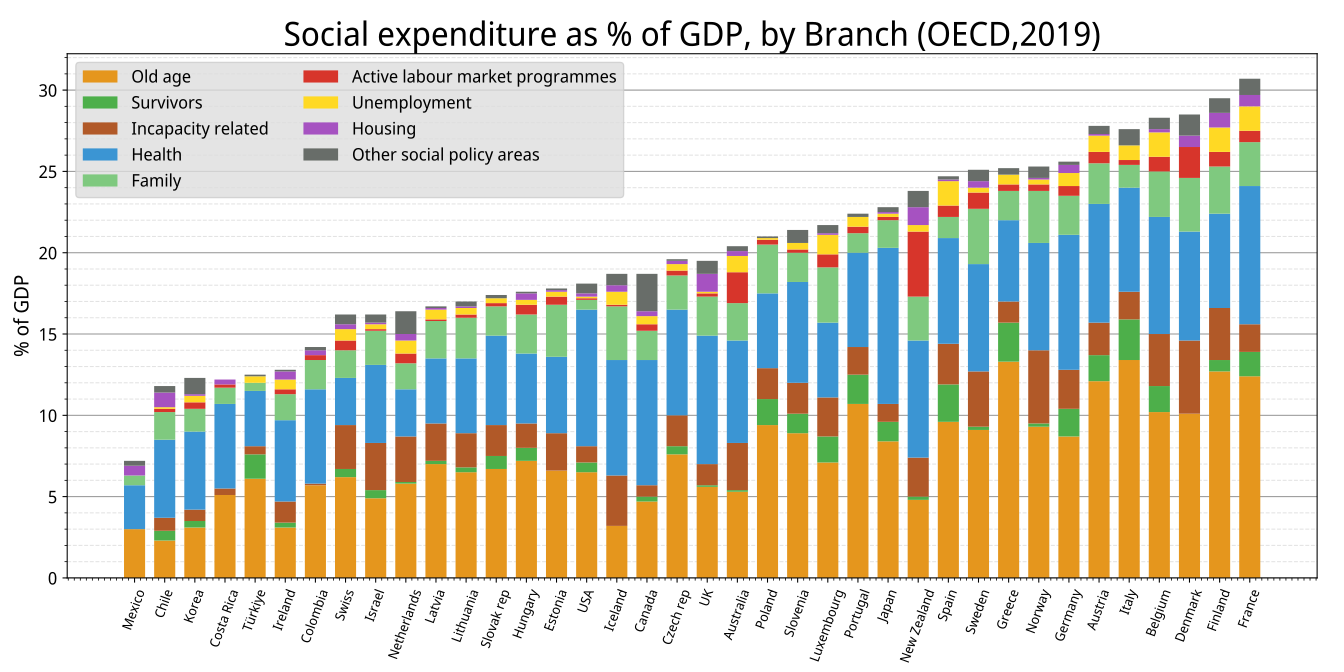
Globally, the scale of welfare state spending varies dramatically. Nordic countries, like Sweden and Denmark, consistently rank among the highest spenders, often exceeding 25% of GDP on social welfare programs. The proportion of the population covered by social security schemes also differs; for instance, unemployment benefits in Germany cover approximately 80% of the workforce, while in the United States, the coverage rate for certain benefits can be significantly lower. Public healthcare expenditure as a percentage of total health spending reached 73% in the UK in 2021, illustrating the deep public commitment in some nations.
👥 Key People & Organizations
Key figures instrumental in shaping welfare state ideology include Otto von Bismarck, who introduced the first comprehensive social insurance schemes in Germany, and William Henry Beveridge, whose 1942 report laid the groundwork for Britain's post-war welfare state. John Maynard Keynes provided the macroeconomic rationale for state intervention to stabilize economies and maintain full employment, crucial for funding social programs. On the organizational front, the International Labour Organization (ILO), founded in 1919, has been a persistent advocate for international labor standards and social protection. Think tanks like the Institute for Fiscal Studies in the UK and the Brookings Institution in the US frequently analyze and debate welfare policies, influencing public discourse and policy decisions.
🌍 Cultural Impact & Influence
Welfare state ideology has profoundly shaped modern societies, influencing everything from family structures to urban planning and cultural attitudes towards collective responsibility. The widespread availability of public education has been a major driver of social mobility and human capital development, as seen in countries like South Korea's rapid post-war growth. Public healthcare systems, such as the National Health Service (NHS) in the UK, have become national institutions, deeply embedded in the cultural identity and public consciousness. Conversely, the ideology has also fostered debates about dependency and individual responsibility, influencing artistic expressions and political narratives that either champion or critique the role of the state in citizens' lives. The very concept of citizenship in many nations has evolved to include rights to social security and healthcare, a direct legacy of welfare state principles.
⚡ Current State & Latest Developments
In the early 21st century, welfare state ideology faces significant challenges and transformations. Globalization, aging populations, and the rise of precarious work have strained traditional welfare models. Many countries are grappling with how to adapt their systems, with trends including increased emphasis on activation policies (getting people back to work), privatization of services, and debates over the sustainability of generous pension and healthcare provisions. The COVID-19 pandemic exposed both the resilience and the fragilities of existing welfare states, leading to renewed discussions about universal basic income (UBI) and the need for robust social safety nets. Countries like Germany and Canada have implemented temporary wage subsidy programs and expanded unemployment benefits, highlighting the ongoing relevance and adaptability of welfare state principles in crisis.
🤔 Controversies & Debates
The most persistent controversies surrounding welfare state ideology revolve around its economic impact and philosophical underpinnings. Critics argue that high taxes and extensive social programs stifle economic growth, discourage individual initiative, and lead to government inefficiency and dependency. They point to countries with lower tax burdens and less extensive welfare states as models of economic dynamism. Proponents, conversely, emphasize the role of welfare states in reducing inequality, promoting social stability, and providing essential services that markets alone fail to deliver equitably. Debates also rage over the optimal level of state intervention, the efficiency of public versus private service delivery, and the ethical implications of wealth redistribution. The rise of gig economy work further complicates traditional welfare models, raising questions about who is responsible for providing benefits like sick pay and pensions.
🔮 Future Outlook & Predictions
The future of welfare state ideology is likely to be shaped by ongoing demographic shifts, technological advancements, and evolving economic structures. We can anticipate continued experimentation with new policy instruments, such as forms of universal basic income or personalized social insurance schemes, to address the changing nature of work and societal needs. The tension between universalism and targeted support will persist, as will the debate over funding mechanisms in an era of potentially slower economic growth and increasing global competition. Furthermore, the impact of climate change may necessitate new forms of state intervention and social solidarity. The core question remains: how can states best balance economic competitiveness with the imperative of ensuring a dignified life for all citizens in an increasingly complex world? The answer will likely involve a continuous process of adaptation and reform, rather than a fixed ideological endpoint.
💡 Practical Applications
Welfare state ideology finds practical application in a vast array of public policies and social programs worldwide. Examples include the National Health Service (NHS) in the UK, providing universal healthcare funded by general taxation; the German social insurance system, which mandates contributions from employers and employees for pensions, health, and unemployment benefits; and the Nordic models, characterized by high levels of public spending on education, childcare, and generous parental leave policies. These systems aim to provide economic security, promote health and education, and reduce poverty. In the United States, while not typically labeled a comprehensive welfare state, programs like Social Security, Medicare, and Medicaid represent significant
Key Facts
- Category
- ideology
- Type
- topic