
Contents
Overview
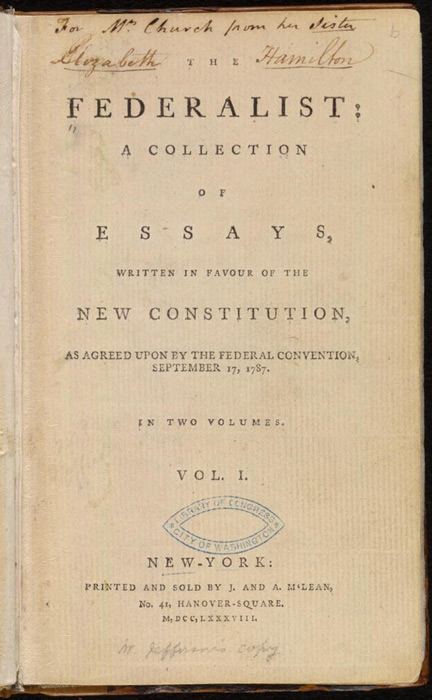
The genesis of The Federalist Papers lies in the fierce debate surrounding the ratification of the United States Constitution in 1787. Following the Constitutional Convention, a vocal opposition, the Anti-Federalists, emerged, raising concerns about the potential for a too-powerful central government. To counter these arguments and champion the proposed framework, Alexander Hamilton conceived the idea for a series of essays. He enlisted James Madison and John Jay to join him in this persuasive endeavor, adopting the collective pseudonym "Publius." The first essays began appearing in the Independent Journal on October 27, 1787, with the authors working at a breakneck pace to address the myriad objections raised against the Constitution. The compilation into two volumes, titled The Federalist: A Collection of Essays, Written in Favour of the New Constitution, as Agreed upon by the Federal Convention, September 17, 1787, was published by J. & A. McLean in March and May 1788, just as New York's crucial ratification convention was underway.
⚙️ How It Works
The Federalist Papers function as a comprehensive argumentative brief for the Constitution, systematically dissecting its structure and defending its provisions. Each essay, penned by one of the three authors (though often without explicit attribution at the time), tackles specific aspects of the proposed government. James Madison's Federalist No. 10, for instance, famously argues that a large republic can effectively control the effects of faction. Alexander Hamilton's contributions, such as Federalist No. 70, advocate for a strong, energetic executive, while Federalist No. 78 lays out the foundation for judicial review. The essays collectively explain the principles of separation of powers, checks and balances, federalism, and the necessity of a union to ensure domestic tranquility and national security, aiming to educate and convince the populace of the Constitution's merits.
📊 Key Facts & Numbers
A total of 85 essays comprise The Federalist Papers, with Alexander Hamilton contributing the lion's share—51 essays. James Madison authored 29, and John Jay penned the remaining 5. The essays were published over a period of 10 months, from October 1787 to August 1788. The initial compilation by J. & A. McLean consisted of 77 essays, with the final 8 appearing later. These essays were instrumental in swaying public opinion, particularly in key states like New York, which ratified the Constitution by a narrow margin of 30-27 on July 26, 1788. The collection has since been translated into over 40 languages, underscoring its global significance.
👥 Key People & Organizations
The primary architects of The Federalist Papers were Alexander Hamilton, James Madison, and John Jay. Hamilton, a key figure in the Federalist Party and the first Secretary of the Treasury, was the driving force behind the project. Madison, often called the "Father of the Constitution," provided crucial intellectual depth, particularly in his analysis of factions. Jay, the first Chief Justice of the United States, contributed essays focusing on foreign affairs and the powers of the executive. The publishing firm J. & A. McLean played a vital role in compiling and disseminating the essays into book form. Opposing voices, such as Anti-Federalists like George Mason and Patrick Henry, articulated significant counterarguments during the ratification debates.
🌍 Cultural Impact & Influence
The influence of The Federalist Papers on American political thought and legal interpretation is immeasurable. They are considered essential reading for understanding the original intent behind the United States Constitution and have been cited thousands of times by the Supreme Court of the United States in landmark decisions, including cases like Marbury v. Madison (1803) and McCulloch v. Maryland (1819). Beyond the U.S., the essays have served as a model for constitutional discourse and nation-building in numerous countries, influencing the drafting of constitutions and legal systems worldwide. Their enduring relevance is reflected in their continued study in political science and law programs globally.
⚡ Current State & Latest Developments
In the contemporary era, The Federalist Papers remain a cornerstone of constitutional scholarship and legal argument. They are routinely referenced in debates concerning the interpretation of the Constitution, particularly in discussions about originalism versus living constitutionalism. The essays continue to be a subject of academic research, with scholars analyzing their rhetorical strategies, philosophical underpinnings, and historical context. Online platforms and digital archives have made the full text of the papers more accessible than ever, facilitating their study by students, legal professionals, and the general public alike. The ongoing discourse surrounding constitutional law ensures that the arguments presented by Hamilton, Madison, and Jay remain actively engaged with.
🤔 Controversies & Debates
One persistent controversy surrounding The Federalist Papers centers on the authorship of several essays, particularly Federalist No. 64, which was attributed to John Jay but is sometimes debated. More broadly, the interpretation of the essays themselves is a source of contention. Debates arise over whether the authors truly intended a limited government or paved the way for a more expansive federal power, a point often raised in discussions of federalism and states' rights. Critics sometimes argue that the essays present an idealized vision that doesn't fully account for the complexities of governance or the potential for governmental overreach, a concern echoed by modern Anti-Federalist sentiments.
🔮 Future Outlook & Predictions
The future of The Federalist Papers' influence hinges on the ongoing evolution of constitutional interpretation. As new legal and political challenges emerge, scholars and jurists will continue to turn to these foundational essays for guidance, albeit with varying degrees of deference. The ongoing debate between originalist and living constitutionalist approaches will likely ensure that the Papers remain a central text in these discussions. Furthermore, as democratic governance models are adopted or adapted globally, the principles articulated by Hamilton, Madison, and Jay may find new applications and interpretations in different cultural and political contexts, potentially influencing constitutional design in emerging nations.
💡 Practical Applications
The most profound practical application of The Federalist Papers lies in their role as a guide to understanding and interpreting the United States Constitution. For lawyers, judges, and policymakers, the essays provide critical insights into the framers' reasoning, informing legal arguments and judicial decisions. They are essential for understanding concepts like separation of powers, checks and balances, and the balance between federal and state authority. For citizens, reading The Federalist Papers offers a deeper appreciation of the foundational principles upon which American democracy is built, empowering them to engage more thoughtfully in civic discourse and hold their representatives accountable based on the Constitution's original intent.
Key Facts
- Category
- history
- Type
- topic